

What should you look for before choosing atlas-focused care, especially if you’re wary of twisting, popping, or cracking? If you’re researching atlas bone adjustment Michigan options, it makes sense to want a clear explanation before considering care. You deserve to understand what an adjustment involves and what it can and cannot promise.
The atlas is the top bone in your neck, where the spine supports your head. NUCCA is a gentle, precise, non-invasive approach to upper cervical, or upper neck, alignment that doesn’t use twisting, popping, or cracking. It is also drug-free and surgery-free, and may reduce the number of treatments needed.
This guide explains the atlas and NUCCA in plain language, what an assessment can involve, and how to set realistic expectations. You’ll also learn about the Anatometer, used as part of the assessment at Precision Spinal Care in Chelsea, Michigan. A consultation gives you a chance to discuss your goals and whether NUCCA may suit your needs.
What Does Atlas Bone Adjustment Mean in Michigan?
The atlas is the first cervical vertebra, also called C1. It sits at the top of the spine, just below the skull. The spinal cord passes through the spinal canal, protected by the vertebrae, and nerves branch from it to connect the brain with the body. This is one reason the upper neck is discussed in relation to the nervous system. That connection alone, however, does not establish the cause of a symptom.
“Atlas bone adjustment” is a broad phrase for care focused on this area. It describes an approach, not a promised result. NUCCA Upper Cervical Care is a specific approach that assesses and supports alignment in the upper neck. The National Upper Cervical Chiropractic Association (NUCCA) provides background on the approach and its history.
How is NUCCA different from a forceful neck adjustment?
NUCCA is a gentle, precise, non-invasive approach that doesn’t use twisting, popping, or cracking. “Upper cervical” simply means the upper part of the neck. Precision Spinal Care in Chelsea uses the Anatometer as part of its assessment. The assessment helps inform the care conversation, but it does not predict a particular outcome. If you’re considering atlas bone adjustment Michigan care, you can learn how the approach works before deciding whether to explore it.
Because “adjustment” can describe different methods, it helps to understand what a specific approach involves. At Precision Spinal Care, you can discuss the assessment, what the care involves, and how your goals inform the conversation. For a deeper technique overview, the clinic’s “What Is NUCCA Chiropractic Care?” article offers more context.
How to Evaluate Atlas Adjustment Options in Michigan
Comparing atlas-focused care is easier when you look beyond the name of a technique. For people considering atlas bone adjustment Michigan options, a clear explanation of the approach helps set realistic expectations. At Precision Spinal Care in Chelsea, Dr. Lisa Olszewski provides NUCCA care, a gentle, non-invasive approach without twisting, popping, or cracking. She is the only chiropractor in Chelsea offering NUCCA. The National Upper Cervical Chiropractic Association also shares information about the method.
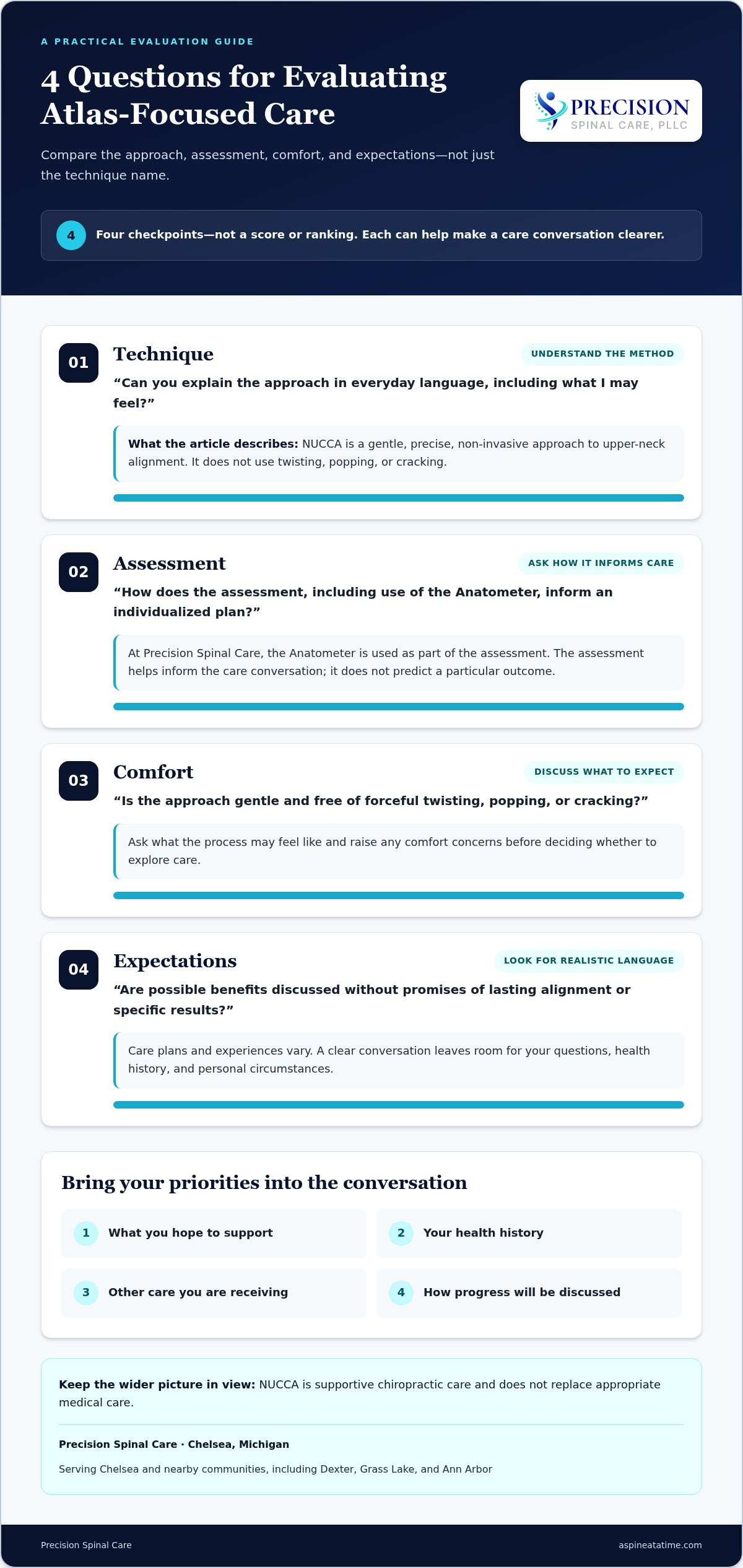
Use these questions to understand what care at Precision Spinal Care involves:
- Technique: Can you explain the approach in everyday language, including what I may feel?
- Assessment: How does the assessment, including use of the Anatometer, inform an individualized plan?
- Comfort: Is the approach gentle and free of forceful twisting, popping, or cracking?
- Expectations: Are possible benefits discussed without promises of lasting alignment or specific results?
These questions distinguish a description of the method from a promise about what it will accomplish. Care plans and experiences vary, so the conversation should leave room for your questions, health history, and personal circumstances.
What questions help clarify whether NUCCA care may suit you?
Share what you hope to support, your health history, and any other care you’re receiving. Ask what the assessment involves, how your goals inform the plan, and how progress will be discussed. NUCCA is supportive chiropractic care and does not replace appropriate medical care. For people in Chelsea, Dexter, Grass Lake, Ann Arbor, Gregory, Pinckney, Manchester, Munith, and Bridgewater, a consultation is an opportunity to discuss whether this approach fits their needs.
Schedule a consultation to learn if NUCCA care may be right for you.
Explore NUCCA Atlas Care with Dr. Lisa O in Chelsea, Michigan
For people exploring atlas-focused care in Chelsea, Dr. Lisa Olszewski brings more than 20 years of NUCCA chiropractic and holistic wellness experience. She holds DC, ND, and FICA designations and is the only chiropractor in Chelsea offering NUCCA. At Precision Spinal Care, this care is part of a full body, no-nonsense approach to healing, a spine at a time.
Precision Spinal Care uses the Anatometer as part of its assessment. To learn more about upper cervical care, the Upper Cervical Monograph is another research and education resource.
What can you expect when exploring NUCCA care locally?
Your first step is a conversation about your goals, health history, and whether gentle NUCCA care may be appropriate for you. You can review what to expect at the clinic to get a sense of the process. The discussion gives you time to understand the approach and ask questions, without assuming a particular outcome or number of visits.
Chiropractic care does not replace medical treatment for Bell’s palsy, trigeminal neuralgia, tinnitus, or post-concussion or traumatic brain injury (TBI) concerns. Continue appropriate medical care for these conditions.
If you’re considering atlas bone adjustment Michigan care, contact Precision Spinal Care in Chelsea to learn more and discuss whether NUCCA may align with your wellness goals.
Take a Thoughtful Next Step Toward Wellness
Choosing care is personal. Take time to ask questions, share what matters to you, and understand how an approach fits your broader wellness goals. If you’re considering atlas bone adjustment Michigan care, learning about NUCCA does not mean committing to a plan. A conversation can help you explore whether this gentle approach feels appropriate for your needs and priorities.
Precision Spinal Care’s approach centers on listening and individualized guidance, not promising the same experience for everyone. The clinic supports people from Chelsea and nearby communities, including Dexter, Grass Lake, Ann Arbor, Gregory, Pinckney, Manchester, Munith, and Bridgewater.
Contact Precision Spinal Care in Chelsea to learn if NUCCA care may be right for you. A clear conversation can help you decide on a thoughtful next step.
Frequently Asked Questions
Is atlas bone adjustment painful?
NUCCA is described as a gentle, painless approach, though individual experiences can differ. If you have concerns about comfort, bring them up during your consultation and ask what the process may feel like. You can share what helps you feel comfortable and ask questions before deciding whether to proceed. No particular result or timing is promised.
Can I book a NUCCA consultation without a referral?
Yes. You can book directly through Precision Spinal Care’s appointment options. A consultation gives you time to share your goals, describe what you hope to support, and ask how the approach may fit your situation. If you’re coming from Chelsea, Dexter, Grass Lake, Ann Arbor, or another nearby community, you can also discuss practical questions about exploring care locally.
How long does a typical NUCCA correction take?
There’s no set appointment duration or visit count that applies to everyone. The time involved can vary with an individual care plan, so a general estimate may not reflect your circumstances. During a consultation, ask how your plan will be discussed and what factors may shape its timing. Avoid relying on a specific timeline before learning about your needs.
Can NUCCA care replace medical care for tinnitus or post-concussion symptoms?
No. Keep your medical professional involved in decisions about tinnitus or post-concussion symptoms, and discuss any complementary chiropractic care with your care team. If Bell’s palsy or trigeminal neuralgia is also part of your health history, include it in that conversation. Sharing relevant details can help your care team coordinate support around your needs.
Disclaimer
This article is for educational purposes only and is not intended to diagnose, treat, cure, or prevent any disease or medical condition. Upper cervical chiropractic care, including NUCCA-based care, focuses on the relationship between the upper spine, nervous system, posture, and overall body function. Individual results may vary, and not every condition or symptom is appropriate for chiropractic care alone. Always consult with a qualified healthcare provider regarding any health concerns, new or worsening symptoms, or before starting any new treatment plan. If you are experiencing a medical emergency, severe pain, sudden neurological symptoms, or other urgent health concerns, seek immediate medical attention.