

What if your “stubborn” midlife weight gain isn’t actually a failure of willpower or a lack of exercise? You’ve likely spent months cutting calories and increasing your daily steps, only to find that the scale refuses to budge while your sleep quality continues to decline. It’s deeply frustrating to feel like your body has suddenly changed the rules, especially when traditional medical providers dismiss your concerns as a “normal” part of aging. You aren’t alone in this struggle, and your frustration is a valid response to a complex internal shift.
In this article, you’ll discover why these metabolic changes happen and how perimenopause weight gain support through functional wellness and nervous system care can help you restore balance. At Precision Spinal Care in Chelsea, Michigan, we see how often women in our community feel unheard while navigating these transitions. We’ll explore the root causes of abdominal fat shifts and sleep disturbances, providing a preview of how optimizing your nervous system can help you regain your energy and confidence. By looking beyond the surface, you can find natural ways to support your metabolism and finally feel like yourself again.
Understanding the Shift: Why Perimenopause Weight Gain Happens
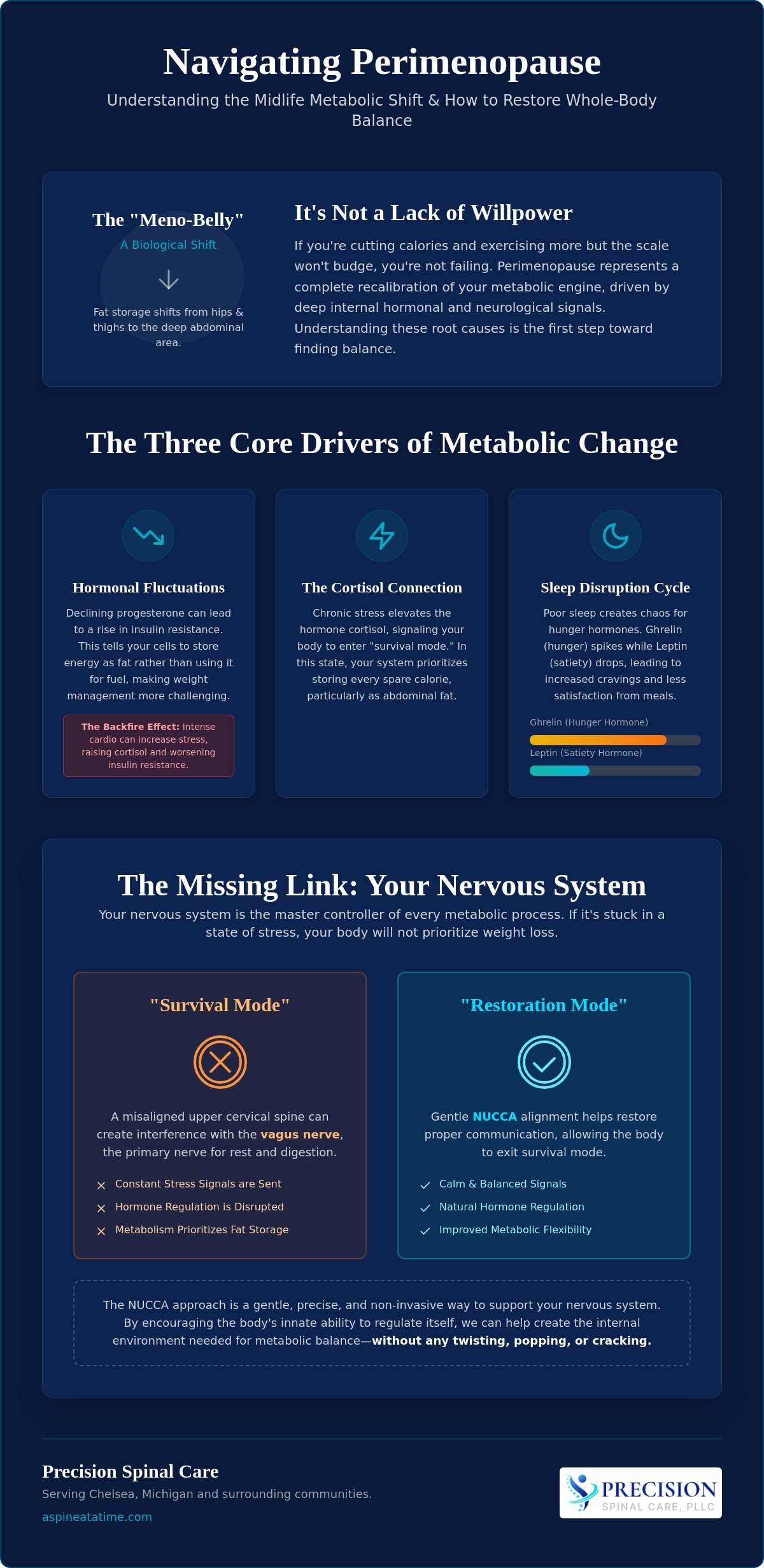
Perimenopause is more than a simple drop in estrogen levels; it represents a complete systemic shift in how your body processes and stores energy. For many women in Chelsea, Michigan, the sudden appearance of “stubborn” weight feels like a betrayal by a body they thought they knew. This isn’t just about aging or a lack of discipline. It is a fundamental recalibration of your metabolic engine. During perimenopause, your body’s priorities change, often leading to the “Meno-Belly” phenomenon. This is when fat storage moves from the hips and thighs to the deep abdominal area.
Why does this happen? In your 40s, chronic stress and rising cortisol levels often act as a loud signal to your body to hold onto every spare calorie for survival. When your nervous system feels under threat, it prioritizes storage over burning. Perimenopause weight gain is a metabolic adaptation to changing hormonal and neurological signals, and as you work to balance these internal systems, you can also discover Davam Aesthetics to see how aesthetic support can boost your confidence during this journey. Finding effective perimenopause weight gain support requires looking at these internal signals rather than just counting calories on a plate.
Hormonal Fluctuations and Insulin Sensitivity
The Role of Sleep and Metabolic Recovery
Restoring sleep is a non-negotiable first step for anyone seeking perimenopause weight gain support. When perimenopausal insomnia disrupts your rest, it creates a chaotic environment for your hunger hormones, ghrelin and leptin. You end up feeling hungrier throughout the day and less satisfied after you eat. At Precision Spinal Care, we believe that optimizing your sleep is essential to help restore metabolic balance. When you improve your sleep quality, you give your body the chance to recover and regulate the very hormones that control your weight and energy levels.
If you’re looking for a personalized approach to these changes, exploring our weight loss services can help you understand the unique needs of your body during this transition.
Functional Trends in Perimenopause Weight Gain Support
Modern approaches to perimenopause weight gain support have evolved far beyond simple calorie counting. Today, we focus on the brain-gut axis to improve how your body sends and receives metabolic signals. Women in Chelsea and Ann Arbor are increasingly turning to personalized weight loss programs that address unique metabolic roadblocks rather than following generic advice. Functional detox supports liver health, which is critical for processing excess hormones. When your liver is supported, it can efficiently clear out the hormonal byproducts that often drive perimenopause weight gain, helping you restore a natural metabolic rhythm and feel more like yourself again.
Gut Health and the Estrobolome
The estrobolome is a specific collection of gut bacteria responsible for metabolizing and excreting estrogen. If your gut microbiome is out of balance, your body may reabsorb hormones that should have been eliminated, leading to systemic inflammation and weight retention. This is why a parasite cleanse program can be a powerful tool to support a healthy microbiome. By clearing out hidden stressors in the gut, you create a foundation for metabolic flexibility and better hormonal signaling, which are essential for long-term weight management and vitality.
Strategic Supplementation for Midlife
One-size-fits-all vitamins often fail because they don’t provide the precision support your body demands during midlife. Strategic supplementation with Omega-3s, Vitamin D, and Magnesium can help promote metabolic health and improve your body’s response to stress. These physician-grade nutrients work together to support metabolic flexibility, making it easier for your body to use fat for fuel. Generic vitamins often lack the precision required for effective perimenopause weight gain support. You might consider reviewing our office information to see how we integrate these functional tools into a personalized plan.
The Missing Link: Nervous System Regulation and NUCCA Care
Your nervous system is the master controller of every metabolic process in your body. When the upper cervical spine is misaligned, it can create subtle interference with the vagus nerve. This vital nerve influences your heart rate, digestion, and how efficiently you burn energy. If your body is stuck in a state of chronic stress, it won’t prioritize weight loss. Choosing perimenopause weight gain support that includes the nervous system helps your body shift from “survival mode” back into a state of balance and restoration.
At Precision Spinal Care, we utilize NUCCA care to help restore this balance. It’s a gentle, non-invasive approach that focuses on precision alignment without any twisting, popping, or cracking. By improving the health of your upper spine, we help encourage your body’s natural ability to regulate hormones and manage weight. While a Harvard study on diet and menopause weight gain shows how healthy eating patterns support weight management, the nervous system must be clear to utilize those nutrients effectively. Women experiencing mood swings, brain fog, and stubborn weight gain alongside these metabolic shifts may benefit from exploring a holistic perimenopause support approach that addresses the root cause of these internal communication breakdowns. If the cognitive symptoms feel as overwhelming as the physical ones, our guide to perimenopause brain fog relief explores how addressing the gut-brain axis and spinal alignment can help restore your mental clarity alongside your metabolic health.
Precision Support for the Michigan Community
Our clinic in Chelsea, Michigan, integrates various wellness services with advanced spinal correction to provide a whole-body approach. When you combine structural alignment with a personalized menopause weight loss plan, you address both the internal signals and the external habits. This dual approach helps improve function across your entire system, making your wellness goals feel achievable again.
Your Next Steps Toward Metabolic Balance
If you’re feeling stuck, a consultation is the best way to determine if your nervous system is contributing to your weight challenges. We’re proud to serve women in the Dexter and Ann Arbor areas who are ready to take a proactive, preventative approach to their health. You don’t have to navigate these midlife changes alone. Contact Precision Spinal Care in Chelsea, Michigan to learn if NUCCA care may be right for you and your journey toward lasting balance.
Restore Your Metabolic Balance and Confidence
You don’t have to accept stubborn weight gain as an inevitable part of midlife. Understanding that your body is undergoing a complex metabolic recalibration is the first step toward finding relief. By addressing the brain-gut axis and ensuring your nervous system is free from interference, you can help your body return to a state of natural harmony. Since 2005, we’ve served the Chelsea, Dexter, and Ann Arbor communities with a focus on root-cause healing. Dr. Lisa Olszewski leads our comprehensive brain-gut health programs, combining nutritional wisdom with the specialized NUCCA technique. This gentle approach provides precision spinal alignment without any twisting or cracking, helping to optimize your body’s communication pathways.
If you’re ready for personalized perimenopause weight gain support, we’re here to guide you. Schedule a consultation at Precision Spinal Care in Chelsea, Michigan, to learn if NUCCA care and functional wellness support are right for your journey. There is hope for a vibrant, energetic future where you feel like yourself again.
Frequently Asked Questions About Perimenopause Weight Gain
Is perimenopause weight gain permanent?
Perimenopause weight gain isn’t a permanent sentence. It’s a sign that your body is adapting to new hormonal signals and a shifting metabolic rate. While it feels stubborn, you can encourage your metabolism to find a new balance by focusing on root causes like insulin sensitivity and sleep quality. Many women in the Chelsea area find success when they move away from restrictive dieting toward functional support, such as that provided by PreventisLongevity, that restores their body’s natural regulation.
Can a NUCCA chiropractor help with hormonal weight gain?
A NUCCA chiropractor provides essential perimenopause weight gain support by optimizing the nervous system. Your upper cervical spine protects the brainstem and vagus nerve, which are critical for metabolic signaling and digestion. When your spine is in precision alignment, your body can better manage stress and regulate hormones. This gentle, non-invasive approach helps your system function more efficiently, which is a key piece of the weight management puzzle.
How much weight do women typically gain during perimenopause?
Most women experience a shift in body composition, with an average gain of about 1.5 pounds per year during the menopausal transition. This often results in a total gain of 10 to 15 pounds over several years if lifestyle and metabolic factors aren’t addressed. Much of this weight tends to accumulate around the midsection due to changes in estrogen and rising cortisol levels. Understanding these numbers helps you realize that your experience is a common biological shift.
What is the best way to support metabolism during perimenopause naturally?
The best way to support your metabolism naturally is through a multi-faceted approach that prioritizes your nervous system and gut health. Restoring deep, restorative sleep is critical because it regulates the hormones that control hunger and fullness. You should also focus on nutrient-dense protocols and precision spinal care. At Precision Spinal Care, we help women in Michigan integrate these functional solutions to improve their energy and restore metabolic flexibility without invasive measures. For a deeper look at how a precision-based, multi-layered approach can help you reclaim your energy and move through this phase with clarity, our comprehensive guide to holistic perimenopause support offers valuable insight into restoring balance from the inside out. Many women also find that addressing the cognitive symptoms that accompany this transition is equally important, and our resource on natural perimenopause brain fog relief provides practical examples for restoring mental clarity alongside physical wellness.
Disclaimer
This article is for educational purposes only and is not intended to diagnose, treat, cure, or prevent any disease or medical condition. Upper cervical chiropractic care, including NUCCA-based care, focuses on the relationship between the upper spine, nervous system, posture, and overall body function. Individual results may vary, and not every condition or symptom is appropriate for chiropractic care alone. Always consult with a qualified healthcare provider regarding any health concerns, new or worsening symptoms, or before starting any new treatment plan. If you are experiencing a medical emergency, severe pain, sudden neurological symptoms, or other urgent health concerns, seek immediate medical attention.