

What if the reason your brain feels “stuck” isn’t because you haven’t rested enough, but because your internal circuit breaker is physically misaligned? Many people seeking post concussion syndrome care are told to simply go home and wait for their symptoms to fade, yet they continue to struggle with debilitating brain fog and light sensitivity for months. It’s exhausting to feel like a passenger in your own life while the medical world offers few concrete answers beyond rest.
You deserve a plan that looks deeper than the surface and addresses the root cause of your neurological fatigue. This article will show you how precision upper cervical care helps restore balance to the nervous system and supports a more efficient path to natural recovery. We will examine why the alignment of the upper spine is often the missing piece in the recovery puzzle and how residents in Chelsea, Michigan are finding clearer thinking and improved focus through a gentle, non-invasive approach that prioritizes long-term wellness and neurological health.
Why Concussion Symptoms Persist: The Upper Cervical Connection
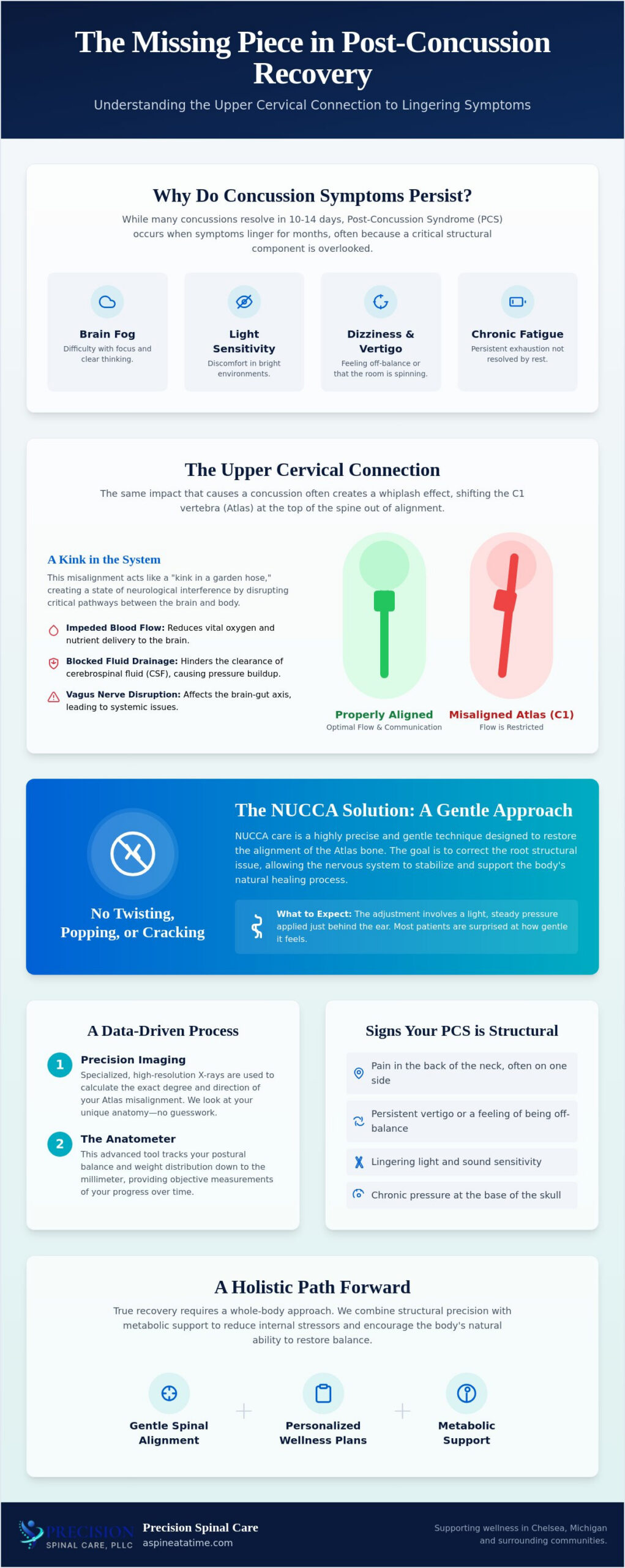
Recovery from a head injury isn’t always a straight line. While many people expect to feel better within two weeks, others find themselves months deep into a cycle of fatigue and confusion. When symptoms linger past the typical 10 to 14 day window, it’s often classified as Post-concussion syndrome. Traditional post concussion syndrome care frequently focuses solely on the brain, but this misses a critical structural component: the neck. The same force that causes a concussion often creates a whiplash effect. This impact shifts the C1 vertebra, or Atlas bone, out of its precise alignment.
This shift isn’t just a minor ache. Finding effective post concussion syndrome care in Chelsea, Michigan often requires looking beyond the skull and examining the structural integrity of the upper neck. Because the Atlas sits at the very top of the spine, a misalignment can physically impede blood flow and the drainage of cerebrospinal fluid. Think of it like a kink in a garden hose. This creates a state of “neurological interference” where the brain cannot communicate effectively with the rest of the body. It’s often why you might feel dizzy or struggle with persistent brain fog long after the initial impact.
The Atlas Bone: The Gateway to Your Nervous System
The C1 vertebra is the most mobile bone in your entire spine, which also makes it the most vulnerable to injury. It acts as the primary protector for the brainstem, the area that controls your most basic life functions. When this bone is even slightly out of place, it can disrupt Vagus Nerve Health, affecting the vital brain-gut axis. This disruption is a common reason why patients in Chelsea, Michigan experience systemic issues like digestive upset or heart rate changes alongside their head injury symptoms.
Signs Your PCS Might Be Structural
If you’ve been searching for natural concussion recovery support, it’s helpful to recognize the physical red flags that suggest your spine is involved. Structural misalignments often present with very specific physical sensations that “brain rest” alone won’t resolve. Common indicators include:
- Pain in the back of the neck on one side
- Persistent vertigo or a feeling of being off-balance
- Lingering light and sound sensitivity
- Chronic pressure at the base of the skull
You can find a more comprehensive list of symptoms on our conditions we treat page to see if your experience aligns with what we see in the office.
Restoring Neurological Flow: A Case Study in NUCCA Care
Sarah from Ann Arbor spent six months visiting various specialists after a minor car accident. She felt constantly drained and struggled to focus on her work. Like many people navigating Postconcussive Syndrome, she was told her brain simply needed more time to rest. When she finally sought post concussion syndrome care at Precision Spinal Care, we began with a comprehensive history and objective neurological testing to see how her nervous system was actually functioning. We didn’t just look at her symptoms; we looked at the structural mechanics of her upper neck.
The NUCCA approach is significantly different from traditional chiropractic. There’s no twisting, popping, or cracking of the spine. Instead, we focus on the precise relationship between the skull and the Atlas bone. By restoring this alignment, we help the body return to a state where it can naturally regulate itself. For Sarah, this meant her brain fog began to lift as the physical pressure on her brainstem was reduced.
While focusing on your neurological health is the priority after an accident, resolving practical burdens can also aid in your overall recovery; those in Michigan may wish to explore Cash for Junk Cars to manage the removal of a damaged or unusable vehicle.
Precision Imaging and the Anatometer
Dr. Lisa uses specialized, high-resolution X-rays to calculate the exact degree of your Atlas misalignment. We don’t rely on general spinal theories. We look at your unique anatomy. To measure your progress, we utilize the Anatometer, a specialized tool that tracks postural balance down to the millimeter. Guessing isn’t an option when your neurological health is on the line. Precision is the only way to ensure we are truly supporting your body’s ability to heal.
The NUCCA Adjustment: What to Expect
If you’re nervous about someone touching your neck, you aren’t alone. The NUCCA adjustment involves a light, steady pressure applied just behind the ear. Most patients are surprised at how gentle it feels. You can read more about the initial visit on our what to expect page. The goal is to get the alignment to “hold” so your nervous system can stabilize over time. You can contact Precision Spinal Care in Chelsea, Michigan to learn more about how this gentle approach supports long-term recovery.
A Holistic Path Forward: Supporting Long-Term Recovery in Chelsea
True recovery from a head injury requires a strategy that looks at the whole person rather than just the initial impact site. When you’re seeking post concussion syndrome care, it’s vital to recognize that your nervous system doesn’t operate in a vacuum. A “whole-body” approach is necessary because persistent symptoms often involve systemic inflammation that rest alone cannot resolve. This approach often starts with having the right primary care team in place; for those looking to establish this foundation, Sage Creek Medical Center offers a useful guide on how to find family doctors. Residents in Chelsea, Dexter, and Grass Lake deserve a recovery model that combines structural precision with metabolic support. By utilizing personalized wellness plans and physician-grade supplements, we can help reduce internal stressors and encourage the body’s natural ability to restore balance.
Precision Spinal Care serves as a community hub for families throughout Washtenaw County who are tired of the “wait and see” medical approach. We focus on creating a supportive environment where your history is heard and your goals are prioritized. Understanding the complex pathophysiology of Post-Concussion Syndrome allows us to build a roadmap that targets the root cause of your fatigue and brain fog. Our mission is to provide more than just a temporary solution; we aim to foster long-term neurological health and vitality.
The Brain-Gut Connection in Concussion Recovery
Many patients are surprised to learn that a head injury can lead to “leaky gut” or digestive distress. The brain and the gut are in constant communication via the vagus nerve. When a concussion occurs, this communication can break down, leading to increased systemic inflammation. We support the healing of this vital axis through our specialized wellness services. Whether it’s through parasite cleansing or targeted detox programs, removing these internal barriers can significantly improve function and help clear the path for faster neurological healing.
Next Steps for Residents in Washtenaw County
If you’re ready to move toward a life of clearer thinking and improved focus, we’re here to guide you. We invite you to meet Dr. Lisa O to learn more about her mission-driven approach to upper cervical health. Taking the first step shouldn’t feel overwhelming or high-pressure. Local residents can review our new patient special offer to see how our precision-focused care can support your unique journey. Contact Precision Spinal Care in Chelsea, Michigan today to learn if NUCCA care may be the right fit for your recovery goals.
Take the Next Step Toward Lasting Neurological Balance
You don’t have to stay trapped in a cycle of persistent brain fog and exhaustion. We’ve explored how a misaligned Atlas bone can disrupt your body’s natural healing process and why a holistic approach is vital for lasting results. By focusing on precision alignment and the brain-gut connection, it’s possible to restore the neurological balance your body needs to thrive. This gentle approach ensures your nervous system can finally reset and begin the work of recovery.
At Precision Spinal Care, we believe in a results-driven path to wellness that prioritizes your long-term health. Dr. Lisa Olszewski is a specialized NUCCA provider with over 20 years of experience helping patients find a way forward. Our practice has been serving the Chelsea, Dexter, and greater Ann Arbor community since 2005 with gentle, non-invasive care that involves no twisting, popping, or cracking. If you’re ready for personalized post concussion syndrome care that addresses the root cause of your symptoms, our team is here to guide you.
Schedule a consultation at our Chelsea clinic to learn if NUCCA care is right for you. Your journey toward clearer thinking and improved focus starts with a single, precise step.
Frequently Asked Questions about Post-Concussion Recovery
How is NUCCA different from traditional chiropractic for concussions?
NUCCA is a specialized, non-invasive approach that focuses exclusively on the alignment of the Atlas bone at the top of the spine. There’s no twisting, popping, or cracking of the neck. We use precision imaging to calculate a gentle, light-pressure adjustment. This method is specifically designed to restore balance to the nervous system without the forceful manipulation that many concussion patients find uncomfortable or jarring.
Is post-concussion syndrome care safe for children and student-athletes?
Yes, this gentle method is a safe option for children and student-athletes in the Chelsea area. Because the adjustment is so precise and involves no manual force, it’s well-suited for young patients whose bodies are still growing. We aim to support the body’s natural recovery process. This helps young athletes optimize their neurological function as they follow the necessary protocols to return to their favorite sports.
How many sessions are typically needed to see an improvement in brain fog?
While every individual responds differently, many people pursuing post concussion syndrome care report noticing a shift in mental clarity within the first few weeks. The focus is on helping your body “hold” its alignment so the nervous system can stabilize. As the physical interference in the upper neck is reduced, the brain can better process information, which often leads to a gradual improvement in focus and a reduction in brain fog.
Can upper cervical care help if my concussion happened years ago?
Yes, it’s possible to see improvements in function even if your injury happened years ago. Structural misalignments in the upper cervical spine don’t usually resolve on their own; they can remain for a long time, causing persistent “short circuits” in your nervous system. By addressing these old misalignments, we can help your body finally reset. It’s never too late to seek a natural path toward better neurological health.
Disclaimer
This article is for educational purposes only and is not intended to diagnose, treat, cure, or prevent any disease or medical condition. Upper cervical chiropractic care, including NUCCA-based care, focuses on the relationship between the upper spine, nervous system, posture, and overall body function. Individual results may vary, and not every condition or symptom is appropriate for chiropractic care alone. Always consult with a qualified healthcare provider regarding any health concerns, new or worsening symptoms, or before starting any new treatment plan. If you are experiencing a medical emergency, severe pain, sudden neurological symptoms, or other urgent health concerns, seek immediate medical attention.