

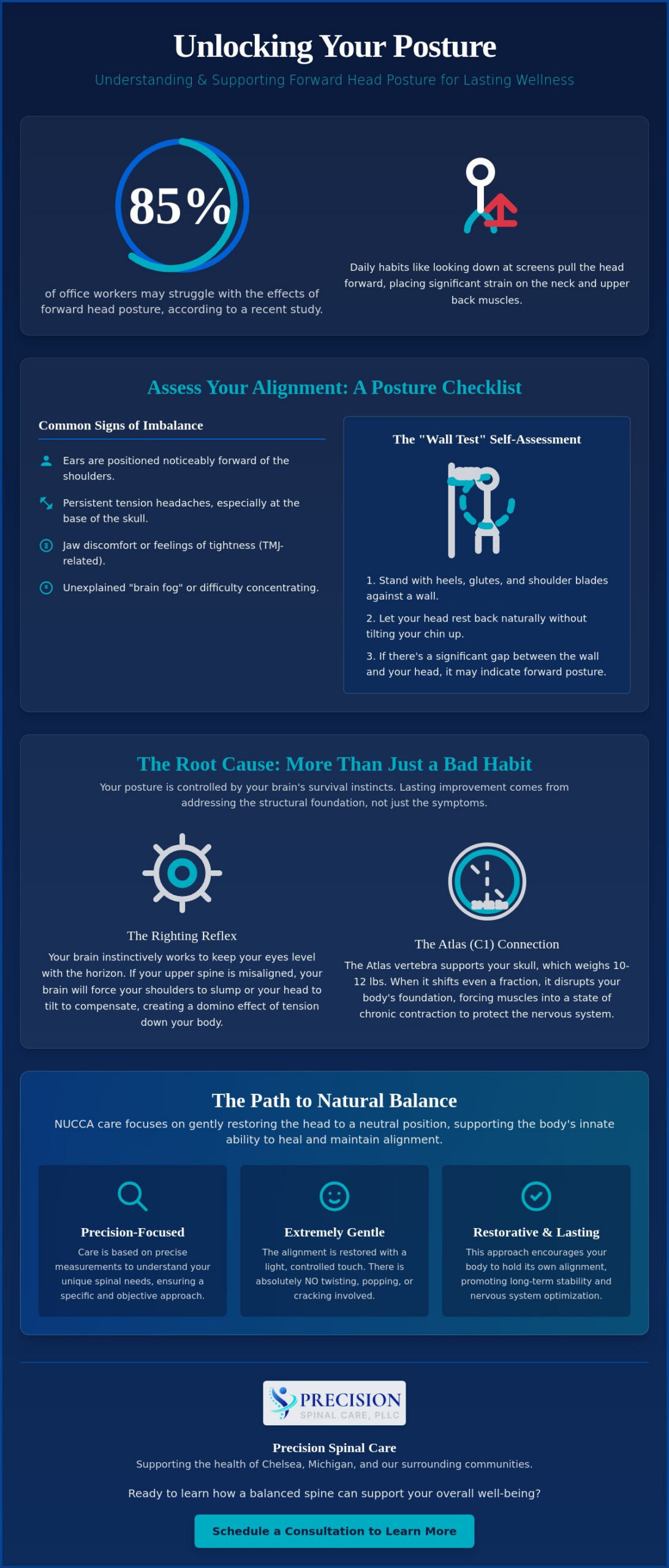
Did you know that a recent 2026 study of office workers found that over 85 percent of individuals struggle with forward head posture? If you’ve spent your day hunched over a screen only to end it with a throbbing tension headache or a stiff, heavy feeling in your shoulders, you’re certainly not alone. It’s frustrating to feel like your body is slumping against your will, especially when it starts to impact your confidence and daily comfort. Correcting forward head posture involves much more than just remembering to stand up straight for a few minutes at a time.
At Precision Spinal Care in Chelsea, Michigan, we believe that lasting change starts with understanding the structural relationship between your head and your spine. You deserve to know why your body has compensated this way and how you can support its return to a natural, balanced state. In this article, you’ll discover how to identify these misalignments and promote the restoration of natural head alignment through a holistic, precision-focused approach. We’ll walk through a comprehensive checklist that explores the root causes of slouching and how gentle, non-invasive care can help you regain your posture and your vitality.
Assessing Your Alignment: A Forward Head Posture Checklist
Awareness is the first step toward lasting change. You can’t begin correcting forward head posture without first knowing where your alignment stands today. Many of our neighbors in Chelsea, Michigan, come to our office feeling frustrated by a constant “slumped” appearance or persistent neck stiffness. They often don’t realize these physical cues are signs that the body is struggling to maintain balance. To truly understand What is Forward Head Posture?, we must look at how the head shifts anteriorly, which places immense strain on the muscles and nerves of the upper neck.
Your daily digital habits often dictate your physical state. How many hours do you spend looking down at a smartphone or leaning into a computer screen? OSHA guidelines recommend keeping the head level and forward-facing, yet modern life often pulls us in the opposite direction. This repetitive downward gaze forces the upper cervical spine to adapt, leading to a cascade of discomfort that affects your entire well-being.
Common Signs You May Need Postural Support
Physical indicators go beyond just a “heavy” head. Observe your profile in a mirror; do your ears protrude past the line of your shoulders? You might also notice rounded shoulders that seem to roll forward, even when you try to stand tall. Secondary symptoms are equally telling. Persistent tension headaches, jaw discomfort, and even unexplained brain fog during work hours often signal that your nervous system is under stress. If you feel a restricted range of motion when turning your head to check traffic, or experience pain in the back of the neck on one side, your body is likely calling for Gentle Spinal Alignment to help restore its natural flow.
The “Wall Test” Self-Assessment
This simple test offers a clear picture of your current head-to-spine relationship. Stand with your back, heels, and shoulder blades flat against a wall. Notice if the back of your head naturally touches the surface without you having to tilt your chin up or strain. If there is a significant gap, have someone help you measure the distance between the wall and the back of your neck to gauge the degree of the tilt. This test is a starting point for awareness, not a clinical diagnosis, but it provides the clarity needed to begin correcting forward head posture with precision and intent.
Why Your Neck Posture Is More Than Just a Bad Habit
Correcting forward head posture is often viewed as a simple matter of willpower, but your brain is actually in the driver’s seat. Your body utilizes a built-in mechanism called the Righting Reflex. This reflex ensures your eyes always stay level with the horizon, no matter how your spine is positioned. If your upper cervical spine is misaligned, your brain will force your shoulders to slump or your head to tilt just to keep your vision steady. It’s a survival tactic. However, this creates a domino effect of tension that travels down your entire back. You can follow a posture assessment checklist daily, but if the structural foundation is off, your muscles will remain in a state of chronic contraction.
The Atlas (C1) vertebra is a tiny bone that supports the weight of your skull, which typically weighs between 10 and 12 pounds. When this bone shifts even a fraction of a millimeter, it compromises your entire structural foundation. Stretching tight muscles provides temporary relief, but it doesn’t address the underlying cause. This is why many people in Chelsea find that their stiffness returns just hours after a massage or a stretch. Without addressing the position of the Atlas, the body will continue to pull itself back into a slumped position to protect the nervous system.
The Atlas Connection to Posture
A gentle NUCCA correction helps restore the head to a neutral position without any twisting, popping, or cracking. By understanding more about Gentle Spinal Alignment, you can see how precision makes the difference in your recovery. Your nervous system must feel safe in a neutral position to finally let go of postural tension. When the Atlas is aligned, your body no longer needs to compensate, allowing for a more natural and confident physical appearance. This precision-focused approach encourages the body to maintain its own balance long-term.
Beyond Muscles: The Nervous System Link
Forward head posture does more than make you look slumped; it increases physical tension on the spinal cord and the surrounding nerves. This neurological stress is a common factor for those seeking natural relief for Migraine Headaches and other chronic tension issues. Our philosophy at Precision Spinal Care focuses on restoring balance rather than forcing change. We believe in helping your body heal itself through alignment and nervous system optimization. If you’re ready to see how this approach can help you, contact our Chelsea office to learn more.
Restoring Natural Balance: Steps for Long-Term Posture Support
How often do you think about your breathing while you’re working? When we slump, we often switch to shallow chest breathing, which forces the secondary muscles in the neck to work overtime. Focusing on deep, diaphragmatic breathing helps reduce this unnecessary strain. This simple shift, combined with regular precision spinal checks, ensures that your head-neck relationship remains stable and resilient against the pressures of modern life. It’s about working with your body’s natural mechanics instead of fighting against them.
Ergonomic Essentials for Chelsea Residents
Many people in our Chelsea community face long commutes to the Ann Arbor area, which can take a toll on the cervical spine. If you’re working from home or spending hours in a car, try the 20-20-20 rule: every 20 minutes, look at something 20 feet away for 20 seconds. This helps reset your visual focus and prevents your head from drifting forward toward your screen. Use this quick checklist to support your alignment:
- Position your monitor so the top third of the screen is at eye level.
- Keep your feet flat on the floor with your knees at a 90-degree angle.
- Ensure your chair provides firm lumbar support to maintain the spine’s natural curve.
When to Seek Professional NUCCA Care
Sometimes, ergonomic adjustments aren’t enough to resolve the underlying issue. If you’ve optimized your desk and tried gentle movements, yet your symptoms of “text neck” or stiffness persist, a structural misalignment might be the culprit. At Precision Spinal Care in Chelsea, Michigan, we offer gentle, non-invasive assessments to determine if your Atlas is out of position. We focus on finding a root-cause solution that promotes whole-body wellness rather than just managing the ache. You don’t have to settle for feeling slumped; schedule a consultation to learn if NUCCA care may be right for you.
Take the Next Step Toward Lasting Alignment
Correcting forward head posture is more than a cosmetic goal; it’s a vital step in optimizing your nervous system and reclaiming your daily comfort. By understanding that your posture is a reflection of your internal spinal balance, you can move away from temporary stretches and toward a sustainable, root-cause solution. Real change happens when the body feels safe and supported in its natural position. When the Atlas vertebra is precisely aligned, the rest of your spine can finally let go of the compensatory patterns that cause stiffness and headaches.
Since 2005, Precision Spinal Care has helped the Chelsea and Ann Arbor communities rediscover the benefits of gentle, non-invasive spinal care. Led by Dr. Lisa Olszewski, our practice utilizes specialized NUCCA techniques that prioritize precision without any twisting, popping, or cracking. We invite you to experience a whole-body approach to wellness that encourages your body to heal and maintain balance naturally. Schedule a consultation at Precision Spinal Care in Chelsea, Michigan to see if NUCCA care is right for you. You deserve to stand tall with confidence and live a life free from the weight of postural strain.
Frequently Asked Questions
Can forward head posture be corrected at any age?
Yes, your body possesses an incredible ability to adapt and find balance at any stage of life. Whether you’re a senior in Chelsea seeking better mobility or a student in Ann Arbor struggling with “text neck,” restoring spinal balance can help. The focus is on removing neurological interference so your body can support itself more effectively. It’s never too late to prioritize your nervous system and encourage a more natural, upright physical state.
How long does it take to see improvements in head alignment?
Every individual responds differently, but many people notice a shift in their physical comfort shortly after their first precision adjustment. Long-term progress in correcting forward head posture depends on your body’s ability to hold its new, balanced position. While initial relief from tension is common, the restoration of natural alignment is a cumulative process that typically takes several weeks of consistent support to become stable and lasting.
Will exercises alone help my neck posture?
Exercises are an excellent way to strengthen supporting muscles, yet they often provide only temporary relief if the structural foundation is misaligned. If your Atlas vertebra is shifted, your muscles will stay tight to protect your spinal cord. Correcting forward head posture requires a “top-down” approach where the spine is first balanced. Once the skeletal structure is stable, gentle movements can then effectively help maintain that newfound mobility and strength.
Is forward head posture causing my headaches?
Forward head posture is a very common contributor to persistent tension and neurological stress that often leads to headaches. When the head shifts forward, it places immense strain on the upper cervical nerves and muscles. Many of our neighbors in Chelsea find that seeking a natural solution for their alignment helps reduce the frequency of these episodes. Restoring balance to the upper neck can promote significant relief and improve overall function. If you also experience pain in the back of the neck on one side, this asymmetry may point to an underlying structural imbalance that deserves a closer look.
Disclaimer
This article is for educational purposes only and is not intended to diagnose, treat, cure, or prevent any disease or medical condition. Upper cervical chiropractic care, including NUCCA-based care, focuses on the relationship between the upper spine, nervous system, posture, and overall body function. Individual results may vary, and not every condition or symptom is appropriate for chiropractic care alone. Always consult with a qualified healthcare provider regarding any health concerns, new or worsening symptoms, or before starting any new treatment plan. If you are experiencing a medical emergency, severe pain, sudden neurological symptoms, or other urgent health concerns, seek immediate medical attention.