

What if the reason your brain fog and fatigue haven’t lifted isn’t because your brain hasn’t healed, but because your neck is still holding onto the impact? While initial diagnostics at a hospital or Premium Urgent Care are vital for ruling out acute trauma, many people in Chelsea, Michigan, are told to simply wait and see after a head injury. This leads many to seek upper cervical care for post concussion syndrome when traditional advice fails to address lingering symptoms. It’s incredibly frustrating to feel like you’re stuck in a holding pattern while the world moves on.
This article explains how precise, non-invasive adjustments to the upper neck can help support the nervous system and promote natural recovery. We’ll explore the structural connection between the Atlas bone and your brain’s ability to recover, offering a gentle path back to the activities you love. Understanding the structural root cause of your symptoms is the first step toward clearer thinking and lasting balance.
Beyond the Brain: Why Your Neck is the Missing Link in Post-Concussion Recovery
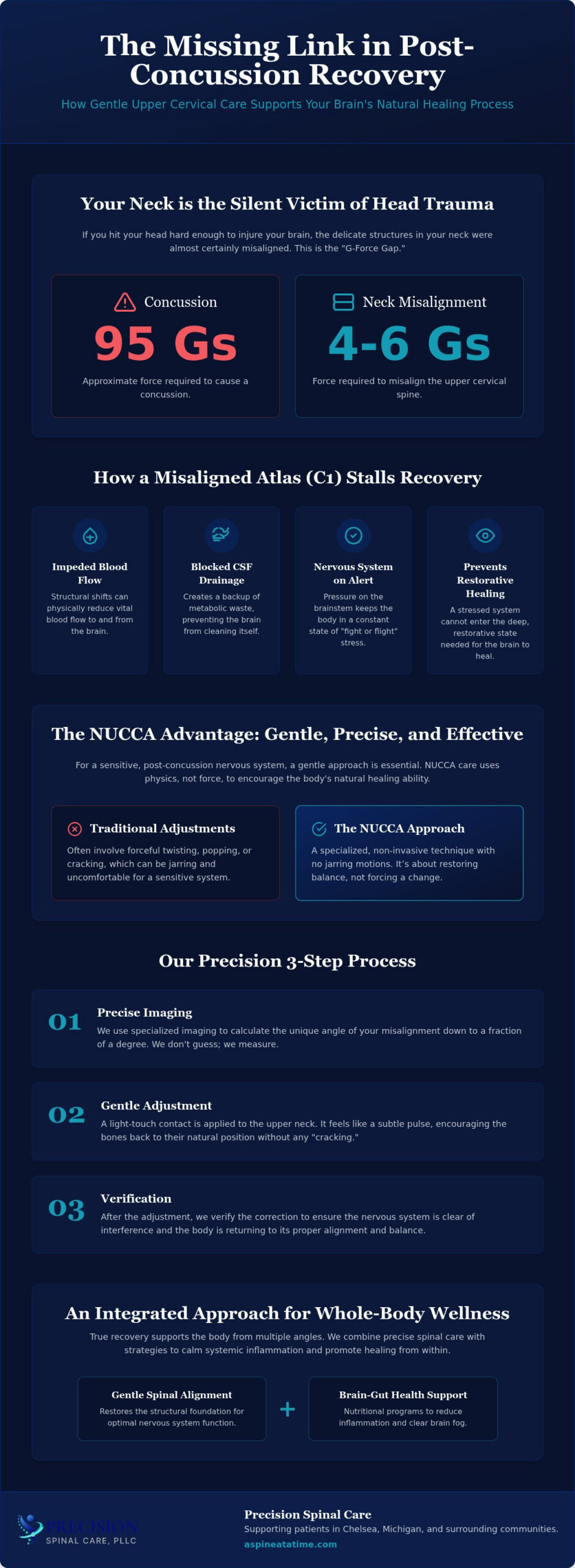
A concussion is rarely just a temporary bump. For many in Chelsea, Michigan, it evolves into Post-concussion syndrome, a complex set of lingering symptoms that can stall your daily life. While most medical attention focuses solely on the brain, the neck is often the silent victim of the same trauma. Think about the “G-force gap.” It takes approximately 95 Gs of force to cause a concussion, yet it only takes 4 to 6 Gs to misalign the delicate vertebrae in your upper neck. If you hit your head hard enough to injure your brain, you almost certainly shifted the structural foundation of your spine.
When the Atlas bone (C1) shifts out of its proper alignment, it does more than cause a stiff neck. It can physically impede blood flow and the drainage of cerebrospinal fluid (CSF), which acts as the brain’s cooling and filtration system. This creates a backup of metabolic waste and structural “noise” that keeps your nervous system in a state of high alert. This constant stress prevents your brain from entering the deep, restorative state required for natural healing. This is why upper cervical care for post concussion syndrome is so vital; it helps remove the mechanical barriers to recovery.
The Craniocervical Junction and Your Nervous System
The craniocervical junction, where your skull meets your spine, is the most mobile and vulnerable part of your body. The C1 and C2 vertebrae lack the interlocking joints found in the rest of the spine, making them susceptible to the sudden jolts that cause head injuries. Misalignment here can put direct pressure on the brainstem, which manages your balance, heart rate, and cognitive processing. By using chiropractic services focused on precision, we help restore balance to this area and encourage your nervous system to function as it should.
The NUCCA Advantage: Supporting Recovery Without the “Crack”
If you’re dealing with light sensitivity or cognitive fatigue, the last thing you want is forceful movement. Traditional manual adjustments often involve twisting or popping, which can feel aggressive to a sensitive nervous system. NUCCA offers a specialized, non-invasive alternative that uses physics rather than force. By focusing on the exact mechanics of the upper neck, this technique helps restore balance to the nervous system and promotes natural healing without any jarring motions. To learn more about the mechanics behind this approach, read What is NUCCA Chiropractic Care? The Science of Gentle Spinal Alignment.
Choosing upper cervical care for post concussion syndrome means prioritizing precision. We don’t guess; we measure. This level of detail is vital for patients who need a calm environment and a gentle touch to encourage their body’s recovery process. It’s about working with your body’s natural structure to improve function rather than forcing a change.
The 3-Step Process of Precision Spinal Alignment
Our approach is methodical and purposeful. We follow a strict protocol to ensure your nervous system receives the exact support it needs:
- Step 1: Precise Imaging. We use specialized imaging to calculate the unique angle of your misalignment down to a fraction of a degree. This ensures the adjustment is tailored to your specific anatomy.
- Step 2: Gentle Adjustment. A light-touch adjustment is applied to the upper neck. It feels like a light pulse, encouraging the bones to return to their natural position without any “cracking.”
- Step 3: Verification. We verify the correction to ensure the nervous system is clear of interference and the body is returning to its proper alignment.
If you’re ready to see how this gentle method can help you, contact Precision Spinal Care in Chelsea, Michigan to learn more about our personalized wellness plans.
Personalized Care in Chelsea: Your Journey to Whole-Body Wellness
At Precision Spinal Care in Chelsea, Michigan, we believe your recovery should be as unique as your story. Dr. Lisa Olszewski has provided specialized NUCCA care since 2005, bringing a results-oriented yet deeply empathetic approach to every consultation. We don’t rely on guesswork. Our intake process includes a thorough history and the use of the Anatometer. This specialized tool measures postural imbalance with incredible accuracy, revealing exactly how your body is leaning or twisting to compensate for a misaligned Atlas bone.
We invite residents from Dexter, Ann Arbor, and Grass Lake to move beyond “wait and see” medical advice. It’s time to take a proactive path toward health. By focusing on the structural root cause of your symptoms, we help restore balance to your entire system. This personalized care ensures that upper cervical care for post concussion syndrome is tailored to your specific structural needs, providing the stability your body requires to promote natural recovery.
Integrating Brain and Gut Health for Concussion Support
Healing the gut is essential for clearing the persistent “brain fog” that often follows a head injury. Inflammation in the digestive tract can send signals to the brain that keep it in a state of stress, which can slow down your progress. Our wellness services include nutritional consultations and brain-gut programs designed to reduce this systemic inflammation. When you combine these holistic strategies with upper cervical care for post concussion syndrome, you’re supporting your body from multiple angles. This integrated approach helps you return to work and family life with more energy and mental clarity.
Take the Next Step Toward Lasting Mental Clarity
Lingering concussion symptoms don’t have to be your permanent reality. By looking beyond the brain and addressing the structural foundation of the neck, you can finally find the underlying cause of your fatigue and brain fog. Upper cervical care for post concussion syndrome offers a precise, non-invasive path that respects your body’s sensitivity. Dr. Lisa Olszewski has provided this specialized NUCCA care in Chelsea since 2005, helping patients restore balance through gentle alignment and comprehensive brain-gut health programs. You deserve a recovery plan that looks at the whole picture, from spinal precision to nutritional support. It’s time to move past the “wait and see” approach and embrace a proactive strategy for your wellness.
Your journey back to a vibrant, active life starts with a single, gentle step toward better nervous system health and a balanced body.
Frequently Asked Questions
Can a chiropractor help with post-concussion symptoms like brain fog?
Yes, upper cervical care for post concussion syndrome can help by addressing the structural root cause of cognitive fatigue. Brain fog is often linked to restricted blood flow or nerve interference at the craniocervical junction. By restoring precise alignment to the Atlas bone, we help promote better circulation and nervous system function. This support allows your brain to shift into a restorative state, encouraging mental clarity and better focus.
How is the NUCCA technique different from traditional chiropractic care for concussions?
NUCCA differs from traditional chiropractic care because it involves no twisting, popping, or cracking of the spine. While traditional methods often use manual force, NUCCA uses physics and precise imaging to calculate a gentle, light-touch correction. This non-invasive approach is specifically designed to support sensitive patients who may have a low tolerance for the forceful movements or sounds associated with more traditional spinal adjustments.
Is it safe to have my neck adjusted after a recent head injury?
Gentle spinal alignment is considered safe for those recovering from head trauma because it avoids all rapid or jarring motions. We prioritize a thorough intake process and precise measurements to ensure we understand your structural needs before providing support. This cautious, data-driven approach helps protect your nervous system and promotes a stable environment where your body can focus on its natural healing and recovery. Because recovery often involves more than just physical alignment, Norton Wellness offers psychiatric and mental health services for adults to help manage the emotional symptoms that can follow a concussion.
Recovery times vary based on the severity of the injury and how long symptoms have persisted. Many patients in our Chelsea, Michigan office notice an improvement in their overall function within the first few weeks of care. Our primary objective is to help your body hold its alignment, which reduces systemic stress and allows for long-term stability. We’ll discuss a personalized schedule during your initial consultation.
Disclaimer
This article is for educational purposes only and is not intended to diagnose, treat, cure, or prevent any disease or medical condition. Upper cervical chiropractic care, including NUCCA-based care, focuses on the relationship between the upper spine, nervous system, posture, and overall body function. Individual results may vary, and not every condition or symptom is appropriate for chiropractic care alone. Always consult with a qualified healthcare provider regarding any health concerns, new or worsening symptoms, or before starting any new treatment plan. If you are experiencing a medical emergency, severe pain, sudden neurological symptoms, or other urgent health concerns, seek immediate medical attention.