Could an eye that tightens when you smile be connected to facial nerve recovery? Facial nerve synkinesis describes unintended linked movements, such as an eye narrowing during a smile. Bell’s palsy recovery support in Ann Arbor starts with understanding these changes and getting appropriate evaluation for new facial paralysis at an urgent care center or emergency department.
Recovery can take up to one year or longer, so wanting clear guidance and a thoughtful plan is understandable. This article explains synkinesis, outlines facial retraining and other multidisciplinary care options, and discusses how supportive wellness care in the Ann Arbor and Chelsea, Michigan, area may fit in. Understanding what each approach can and cannot offer can help you make informed decisions about next steps.
When Bell’s Palsy Changes Your Daily Routine
A weaker smile, difficulty closing one eye, or food slipping from one side of the mouth can make familiar routines unexpectedly challenging. Bell’s palsy-related facial weakness may affect blinking, clear speech, eating, drinking, and expressing emotion. Even a simple conversation can feel different when one side of your face does not move as expected.
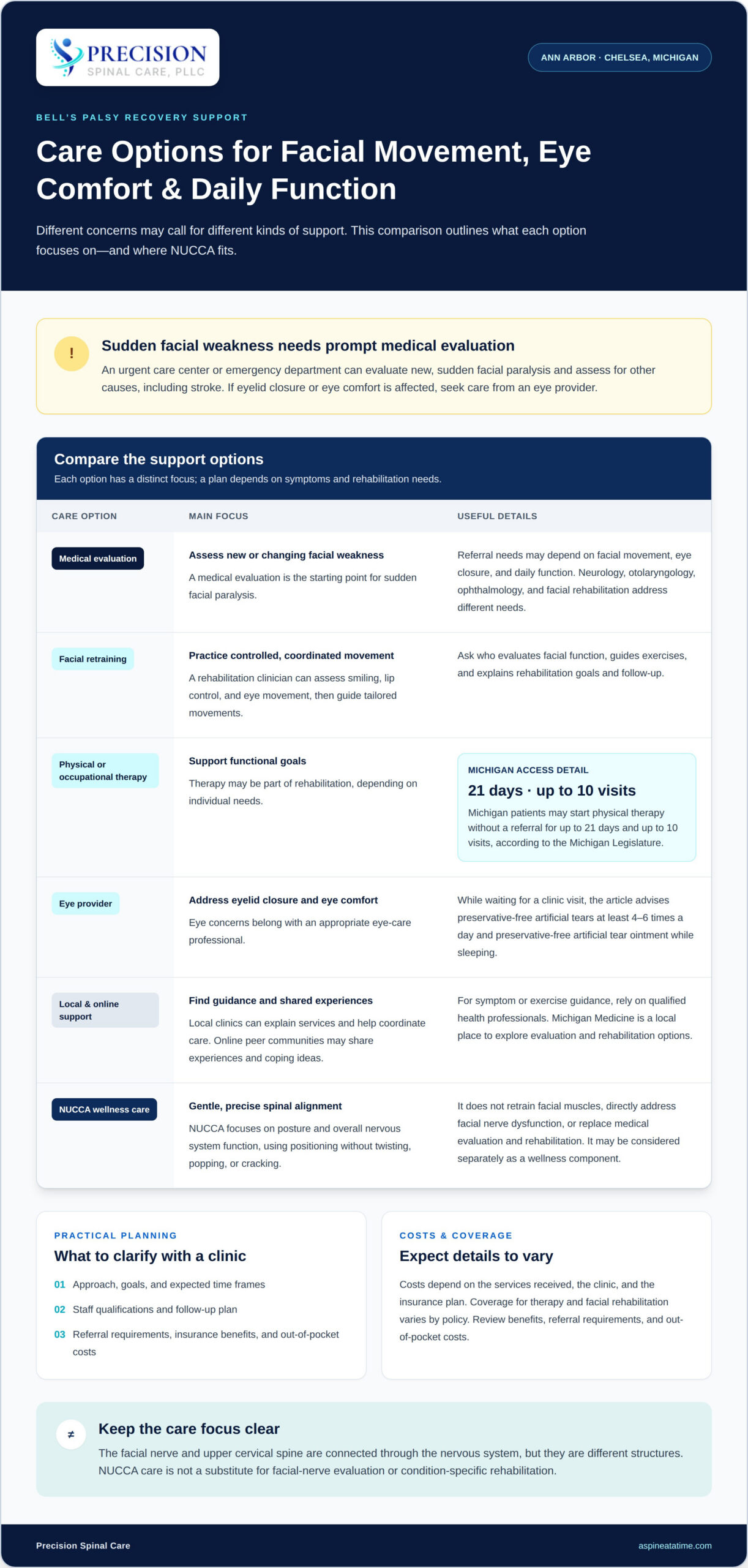
New, sudden facial paralysis should be evaluated at an urgent care center or emergency department to rule out other causes of facial weakness. If an eyelid is affected, seek care from an eye provider. While waiting for a clinic visit, use preservative-free artificial tears at least 4-6 times a day and preservative-free artificial tear ointment while sleeping.
These steps can support eye comfort and protection, while the broader recovery plan depends on your symptoms and how facial movement changes. Difficulty closing an eye may make reading or screen use tiring, while reduced lip control can make meals and speech frustrating. These changes can affect both physical comfort and confidence in social settings. Clear guidance can help you manage daily needs while exploring appropriate support in Ann Arbor and nearby Chelsea, Michigan.
How the Upper Cervical Spine and Nervous System Connect
The facial nerve and upper neck are connected through the nervous system, but they are different structures. The facial nerve begins near the brainstem and carries signals that help control facial expression. The upper cervical spine supports the head and surrounds the upper spinal cord, part of the pathway that carries messages between the brain and body.
This connection does not mean that a neck alignment issue causes Bell’s palsy or that neck adjustments restore facial nerve function. Bell’s palsy involves the facial nerve, so sudden facial weakness needs appropriate medical evaluation. Understanding the distinction helps keep expectations clear and care focused on the right concern.
NUCCA care uses gentle, precise spinal alignment to support posture and overall nervous system function. It does not address the facial nerve injury itself or replace medical care for facial paralysis. For some people, upper cervical chiropractic care may be considered as a separate part of broader wellness support, alongside guidance from appropriate health professionals in Ann Arbor or Chelsea, Michigan.
Bell’s Palsy Care Options in Ann Arbor
Care options may include evaluation, facial retraining, and support for daily function. The plan depends on each person’s symptoms and rehabilitation needs.
Care and Rehabilitation Options
Facial retraining uses customized exercises to practice controlled movement. Physical or occupational therapy may support functional goals. According to the Michigan Legislature, Michigan patients may start physical therapy without a referral for up to 21 days and up to 10 visits. Michigan Medicine is a local place to explore evaluation and rehabilitation options. Sudden facial weakness needs urgent evaluation to rule out causes such as stroke.
Care Costs and Insurance Coverage
Costs vary depending on the services received, clinic, and insurance plan. Coverage for therapy and facial rehabilitation also varies by policy. Review your plan’s benefits, referral requirements, and out-of-pocket costs. Bell’s palsy recovery support in Ann Arbor can involve different services, so expenses depend on the care involved.
Local and Online Support
Local clinics can explain their services and help coordinate care. Online peer communities may offer shared experiences and practical coping ideas. For guidance about symptoms or ongoing health needs, relying on qualified health professionals and comprehensive primary care organizations like HealthWorksPros can help you stay supported. Bell’s palsy recovery support in Ann Arbor may include both clinical guidance and peer connection.
Before choosing a facility, ask questions to clarify what care involves. Discuss the approach, goals, expected time frames, staff, and financial considerations. These conversations can help you understand the facility’s approach and practical details.
Are There Local Facial Nerve or Facial Paralysis Specialists in Ann Arbor?
Patients in Ann Arbor can start with a medical evaluation. Referrals may depend on facial movement, eye closure, and daily function. Neurology, otolaryngology, ophthalmology, and facial rehabilitation address different needs. An eye provider is important if eyelid closure or eye comfort is affected, keeping eye concerns within the appropriate area of care.
Facial retraining therapy uses tailored movements to practice coordinated expressions. A rehabilitation clinician can assess smiling, lip control, and eye movement. Ask which professional evaluates facial function and guides exercises. Trinity Health Michigan says neuropsychology evaluations may help assess thinking, memory, or speaking challenges. Results can help determine appropriate therapies and clarify needs beyond visible facial movement.
Bring a brief symptom timeline to your appointment, including changes in blinking, eating, or speech. If a smile pulls your eye closed, describe the movement precisely. Ask the clinic to explain the evaluation sequence, rehabilitation goals, and follow-up plan. The aim is a functional plan based on specific symptoms, not appearance alone.
For facial nerve disorders that affect the eyelids, seek care from an eye provider. When booking, explain that your concern is related to facial movement and describe how your eyelids are affected. If the problem changes, note what changed and when you first noticed it. Clear details can help focus the visit on your eyelid concern and guide discussion of appropriate evaluation. Ask whether the eye provider should coordinate with the clinician overseeing other facial symptoms and how to share recommendations between providers.
It may help to prepare questions before your visit: which eyelid concerns to discuss, what the next step will be, and whom to contact with follow-up questions. If you have more than one issue, identify which is most disruptive in daily life. These points can make the plan easier to understand and keep care centered on your needs.
Precision Spinal Care: TMJ, Trigeminal Neuralgia, and Bell’s Palsy Support
Precision Spinal Care offers gentle NUCCA upper cervical chiropractic care and supportive wellness care related to Bell’s palsy, TMJ, and trigeminal neuralgia. Dr. Lisa Olszewski is the only chiropractor in Chelsea offering NUCCA. For people seeking Bell’s palsy recovery support in Ann Arbor, this may be a complementary wellness option focused on spinal alignment and nervous system function, not a substitute for medical evaluation or rehabilitation.
NUCCA uses precise, gentle positioning without twisting, popping, or cracking. It does not retrain facial muscles or directly address facial nerve dysfunction. Bell’s palsy recovery support in Ann Arbor may involve different kinds of care; NUCCA is an optional wellness component, not a replacement for condition-specific guidance. A rehabilitation professional or eye provider can support needs involving facial movement or eye closure.
A wellness discussion can consider your health history, posture, and goals. People in Ann Arbor, Chelsea, Dexter, Grass Lake, Gregory, Pinckney, Manchester, Munith, and Bridgewater can explore whether this gentle approach fits alongside their existing care.
For a low-pressure conversation about your wellness goals, contact Precision Spinal Care.
Frequently Asked Questions
What is facial nerve synkinesis?
Facial nerve synkinesis is an unintended movement that occurs alongside another facial action. For example, the cheek or mouth may tighten when you blink. These linked movements can make expressions feel less coordinated. Note which movements happen together and when, such as while chewing or speaking, so you can describe the pattern during a clinical evaluation.
What is facial paralysis?
Facial paralysis means reduced or absent movement in some facial muscles, often on one side. It may affect expressions, blinking, speech, or control of food and drink. Facial weakness can have different causes, so sudden changes need prompt medical evaluation rather than self-diagnosis. The pattern, onset, and other symptoms help clinicians decide what evaluation is needed.
What is Bell’s palsy and how long does recovery usually take?
Bell’s palsy is a form of facial weakness associated with dysfunction of the facial nerve. Recovery from facial paralysis can take up to one year or longer, and progress may not feel steady from week to week. Track changes in movement and daily function, and share new or worsening symptoms with a medical professional.
What approaches support Bell’s palsy recovery, and when should they begin?
Care depends on evaluation findings and may include facial retraining, which uses tailored exercises to practice controlled movement. Synkinesis may also be addressed with retraining, botulinum neurotoxin injections, or surgery in some cases. Sudden facial weakness warrants urgent evaluation first. After assessment, a clinician can determine whether rehabilitation is appropriate and when to begin, based on symptoms and goals.
Disclaimer
This article is for educational purposes only and is not intended to diagnose, treat, cure, or prevent any disease or medical condition. Upper cervical chiropractic care, including NUCCA-based care, focuses on the relationship between the upper spine, nervous system, posture, and overall body function. Individual results may vary, and not every condition or symptom is appropriate for chiropractic care alone. Always consult with a qualified healthcare provider regarding any health concerns, new or worsening symptoms, or before starting any new treatment plan. If you are experiencing a medical emergency, severe pain, sudden neurological symptoms, or other urgent health concerns, seek immediate medical attention.