

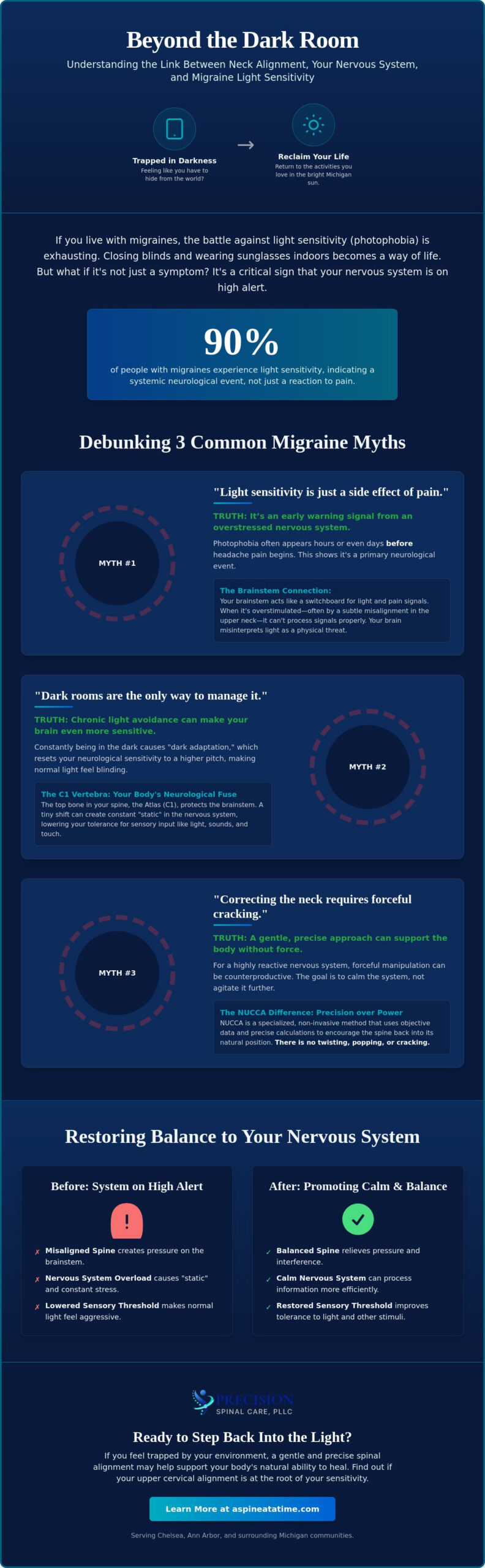
What if your “vampire lifestyle” isn’t actually a mandatory sentence for living with migraines? You know the drill: closing the blinds, wearing sunglasses indoors, and missing out on beautiful days in Chelsea because the sun feels like a physical assault. It’s exhausting to feel like your world has to shrink just to keep the pain at bay. Many people assume migraine headaches light sensitivity is just an inevitable side effect of the pain, but it’s actually a complex neurological response. Research shows that up to 90 percent of people experience this sensitivity during an attack, yet it often indicates that the nervous system is in a state of high alert.
We understand the frustration of medications that don’t stop the glare and the feeling of being trapped in a dark room. In this article, we’ll debunk three common myths about photophobia and explain the critical link between your upper neck and how your brain processes visual input. You’ll discover how gentle spinal alignment can support your nervous system and help restore balance without any twisting or cracking. It is time to learn how you can move beyond dark rooms and return to the activities you love in the bright Michigan sun.
Myth #1: Light Sensitivity is Just a Side Effect of Migraine Pain
Many people believe they must simply survive the headache for the light sensitivity to fade. This is a common misconception. Photophobia often acts as an early warning signal, appearing hours or even days before the first throb of pain begins. This timing proves that migraine headaches light sensitivity is a systemic neurological event rather than just a reaction to physical discomfort. It’s about your nervous system’s “threshold.” When your system is stressed or misaligned, its ability to filter environmental input drops significantly. Suddenly, a standard lamp in your Chelsea living room feels like a blinding spotlight.
Think of your brainstem as a busy switchboard. It handles incoming signals for both light and pain. If this switchboard is overstimulated, it can’t distinguish between the two signals properly. Waiting for the pain to stop won’t necessarily restore balance to your system if the underlying neurological stress remains. This is why many people find that even after the headache passes, they still feel “fragile” in bright environments.
The Trigeminal Nerve Connection
The trigeminal nerve is the primary pathway for sensations in your face and head; it also carries light-sensitivity signals to the brain. When there is irritation near the top of the spine, specifically in the upper cervical area, these signals can “leak” into one another. Your brain essentially misinterprets the data, processing bright light as a physical threat. This is why many of our neighbors seeking Headache and Migraine Support find that supporting the neck is the key to calming the eyes.
Furthermore, since the trigeminal nerve also controls sensations in the jaw, maintaining oral health is another vital component of neurological wellness; for instance, the team at Peacock Dental Spa emphasizes how dental care can contribute to a more stable and comfortable sensory experience.
Why “Normal” Light Feels Aggressive
Imagine a radio with a broken volume knob. Even if the music is beautiful, it becomes painful if the volume is stuck at maximum. In a healthy state, your brain filters out the “noise” of everyday light. When you’re struggling with migraines, that filter fails. Photophobia is a neurological overreaction where the brain treats standard visual input as an aggressive intrusion rather than a simple eye problem.
Myth #2: Dark Rooms and Sunglasses are the Only Ways to Manage Photophobia
Retreating to a windowless room often feels like the only way to survive. However, chronic light avoidance can actually backfire. When you spend too much time in total darkness, your brain undergoes a process called dark adaptation. Your neurological system resets its sensitivity levels to a higher pitch, making even dim light feel blinding when you finally step out. Since photophobia is a recognized diagnostic criterion for migraine, managing it requires more than just hiding. It requires addressing why your body’s “alarm system” is stuck in the on position.
Misalignment in the upper neck often creates constant “static” in the nervous system. This interference lowers your overall tolerance for sensory input. Instead of just wearing darker lenses, we look to restore balance from the inside out. By improving how the brainstem processes information, we can help your body naturally filter out environmental triggers that currently feel overwhelming.
The C1 Vertebra: Your Body’s Neurological Fuse
The Atlas bone, or C1, is the top-most vertebra in your spine. It sits in a delicate position surrounding the brainstem, acting as a protector for your most vital neurological pathways. Because of this proximity, even a tiny shift in its alignment can lead to chronic nervous system stress. This stress frequently manifests as migraine headaches light sensitivity. When the Atlas is off-balance, it puts pressure on the areas that regulate sensory thresholds, making you feel hypersensitive to everything from bright sun to computer screens. Poor head positioning, such as the kind that develops from hours at a desk, can compound this problem — which is why correcting forward head posture is often an important part of restoring proper cervical alignment and reducing neurological stress.
Restoring Your Internal Threshold
Precision spinal alignment works to “turn down the volume” on this sensory overstimulation. We use the NUCCA method to encourage the spine back into its natural position without any twisting, popping, or cracking. This gentle approach helps restore nervous system support and improves overall function. Many of our neighbors in Chelsea and Ann Arbor find they can return to outdoor activities and bright environments once their spinal balance is restored. If you feel trapped by your environment, you may want to contact Precision Spinal Care to see if your upper cervical alignment is the root cause.
Myth #3: Correcting the Neck for Migraines Requires “Cracking” or Force
The biggest hurdle for many people in pain is the fear of traditional chiropractic methods. If you are currently dealing with migraine headaches light sensitivity, the idea of someone twisting or popping your neck sounds like a nightmare. This valid concern keeps many people trapped in dark rooms, relying solely on dark lenses or temporary fixes. It is important to know that forceful manipulation is not the only way to address spinal health. In fact, Cervicogenic headache treatments often focus on precision and gentle care to avoid overstimulating an already sensitive nervous system.
NUCCA is a specialized, non-invasive approach that removes the need for “cracking.” We use objective data from the Anatometer and specialized X-rays to calculate the exact angle of your misalignment. This precision allows us to support your body’s natural healing process without any aggressive force. This method is exceptionally safe for those requiring post-concussion support or those with highly reactive nervous systems who cannot tolerate traditional manual adjustments.
The NUCCA Difference in Chelsea, Michigan
The actual alignment process is incredibly subtle. Most patients describe the sensation as a light touch behind the ear, similar to the pressure used to check a pulse. Because we use physics and mathematics to guide the alignment, the body is more likely to hold its correct position for longer periods. This stability helps promote better communication between the brain and the body, allowing your internal “volume” to finally reset to a normal level.
What to Expect at Precision Spinal Care
Your journey begins with a comprehensive evaluation rather than immediate manual work. Our What to Expect process involves a detailed consultation and objective testing to see how your spine and nervous system are functioning. We encourage local residents from Dexter, Grass Lake, and Ann Arbor to seek this specialized evaluation. By identifying the root cause of your light sensitivity, we can help you find a path back to the bright, active life you deserve. Schedule a consultation to learn if NUCCA care may be right for you.
Reclaim Your Life from the Shadows
Living with migraine headaches light sensitivity shouldn’t mean spending your life in a dark room. We’ve explored how photophobia is a complex neurological signal often linked to the upper cervical spine rather than just an eye problem. You don’t have to rely on dark lenses or “wait out” the pain when you can address the root cause by supporting your nervous system. By restoring the proper alignment of the Atlas bone, you can help your brain process sensory information more effectively.
Dr. Lisa Olszewski is a specialized NUCCA provider with over 20 years of experience helping patients restore balance through precision alignment. Since 2005, our practice has served the Chelsea, Ann Arbor, and Dexter communities with non-invasive care that requires no twisting, popping, or cracking. We focus on gentle adjustments that encourage your body’s natural ability to heal and improve function. This precision-based approach offers a path toward lasting relief without the stress of traditional manual adjustments.
It’s time to stop hiding and start living again. Schedule a consultation at Precision Spinal Care in Chelsea, Michigan to see if NUCCA care can help restore your balance. We’re here to help you move toward a brighter, more comfortable future. There is hope for a life where you can step outside and enjoy the sun again.
Frequently Asked Questions
Can a neck misalignment really cause light sensitivity?
Yes, a misalignment in the upper cervical spine can directly influence how your brain processes light. The top vertebra, known as the Atlas, sits very close to the brainstem and the trigeminal nerve. This nerve is responsible for transmitting both pain and light signals to the brain. When the spine is off-balance, it can create neurological “static” that lowers your sensory threshold. This interference often results in migraine headaches light sensitivity because the brain begins to misinterpret normal light as a painful stimulus.
Is NUCCA chiropractic safe to do while I have an active migraine?
NUCCA is remarkably safe during a migraine because it involves no forceful twisting, popping, or cracking. Traditional manual adjustments might feel overwhelming during an attack, but our gentle approach uses a light touch similar to the pressure used to check a pulse. This non-invasive method helps support your nervous system when it’s most vulnerable. By restoring balance to the upper neck, we help promote a calmer neurological state without adding physical stress to your body.
How many sessions does it take to see an improvement in my light sensitivity?
Every individual’s recovery timeline is unique, but many patients notice a shift in their light tolerance within the first few weeks of care. The focus of NUCCA is helping your spine “hold” its alignment rather than providing a temporary adjustment. As your nervous system stabilizes and the pressure on the brainstem is reduced, your body’s ability to filter environmental input typically begins to improve. We use objective testing to monitor your progress and ensure your system is returning to a balanced state.
Will I still need to wear sunglasses indoors after starting NUCCA care?
Our goal is to help you reach a point where indoor sunglasses are no longer necessary. While you might still use them as a “security blanket” during the early stages of care, many residents in the Chelsea area find they can gradually set them aside. As we work to restore balance and improve your internal sensory threshold, your brain becomes better at handling normal indoor lighting. This process encourages a return to a natural state of health where you can enjoy bright environments without discomfort. It is also worth noting that some patients dealing with migraines also experience pain in the back of the neck on one side, which can be another sign that structural imbalance in the cervical spine is contributing to their symptoms.
Disclaimer
This article is for educational purposes only and is not intended to diagnose, treat, cure, or prevent any disease or medical condition. Upper cervical chiropractic care, including NUCCA-based care, focuses on the relationship between the upper spine, nervous system, posture, and overall body function. Individual results may vary, and not every condition or symptom is appropriate for chiropractic care alone. Always consult with a qualified healthcare provider regarding any health concerns, new or worsening symptoms, or before starting any new treatment plan. If you are experiencing a medical emergency, severe pain, sudden neurological symptoms, or other urgent health concerns, seek immediate medical attention.