
by Dr. Lisa Olszewski | Oct 19, 2026 | Uncategorized
Can natural support have a place in your care without replacing medical guidance? Sudden, shock-like facial pain can make everyday moments, from talking to brushing your teeth, feel difficult. If you’re exploring trigeminal neuralgia natural treatment Dexter MI, it’s reasonable to want clear answers about what may help and which claims deserve caution.
Facial pain needs medical evaluation. Natural approaches and NUCCA are not substitutes for medical care. This guide explains the role and limits of supportive options, including how gentle NUCCA upper cervical care may complement your existing care plan. Precision Spinal Care in Chelsea serves people from Dexter and nearby communities. Dr. Lisa Olszewski is the only chiropractor in Chelsea offering NUCCA, a gentle approach without twisting, popping, or cracking.
Trigeminal Neuralgia and Natural Support: What Can It Realistically Offer?
Facial pain can be confusing and unsettling, especially when a light touch, chewing, or brushing your teeth seems to set it off. Wanting a gentle, natural way to support your well-being makes sense. The key is knowing where supportive care ends and medical care begins.
The trigeminal nerve carries sensation from the face to the brain through three main branches. Trigeminal neuralgia can involve sudden, severe, shock-like facial pain along one or more of those branches. The Trigeminal neuralgia overview describes common symptoms and medical approaches. A qualified medical professional must assess facial pain and determine its cause. Supportive wellness care cannot diagnose it.
How to distinguish supportive care from claims about trigeminal neuralgia
Supportive care may focus on comfort and general wellness alongside a person’s medical plan. That is different from claiming to resolve the nerve condition, stop attacks, or replace clinical assessment. Be cautious of any natural approach presented as a cure or a reason to delay medical evaluation. For people considering trigeminal neuralgia natural treatment Dexter MI options, that distinction matters.
Supportive care may complement medical care, but it does not diagnose trigeminal neuralgia or manage the condition in place of a medical professional. Chiropractic care does not replace medical treatment for conditions such as Bell’s palsy, trigeminal neuralgia, tinnitus, or post-concussion/TBI. At Precision Spinal Care in Chelsea, NUCCA is gentle, non-invasive support, not a direct way to address the trigeminal nerve or resolve the condition. Keep your medical provider informed about complementary care you choose, and follow their guidance for evaluation and care.
How to Evaluate Natural Support Safely Alongside Medical Care
Claims about natural approaches can sound convincing, but a careful plan starts with a practical question: what is this approach meant to support, and what evidence backs that specific claim? The National Institute of Neurological Disorders and Stroke (NINDS) offers reliable background on trigeminal neuralgia and its medical care. Use that information to prepare for a conversation with your clinician, not as a substitute for personal medical advice.
Questions to ask before adding a natural approach
Before trying a supplement, wellness program, or hands-on approach, ask your medical clinician:
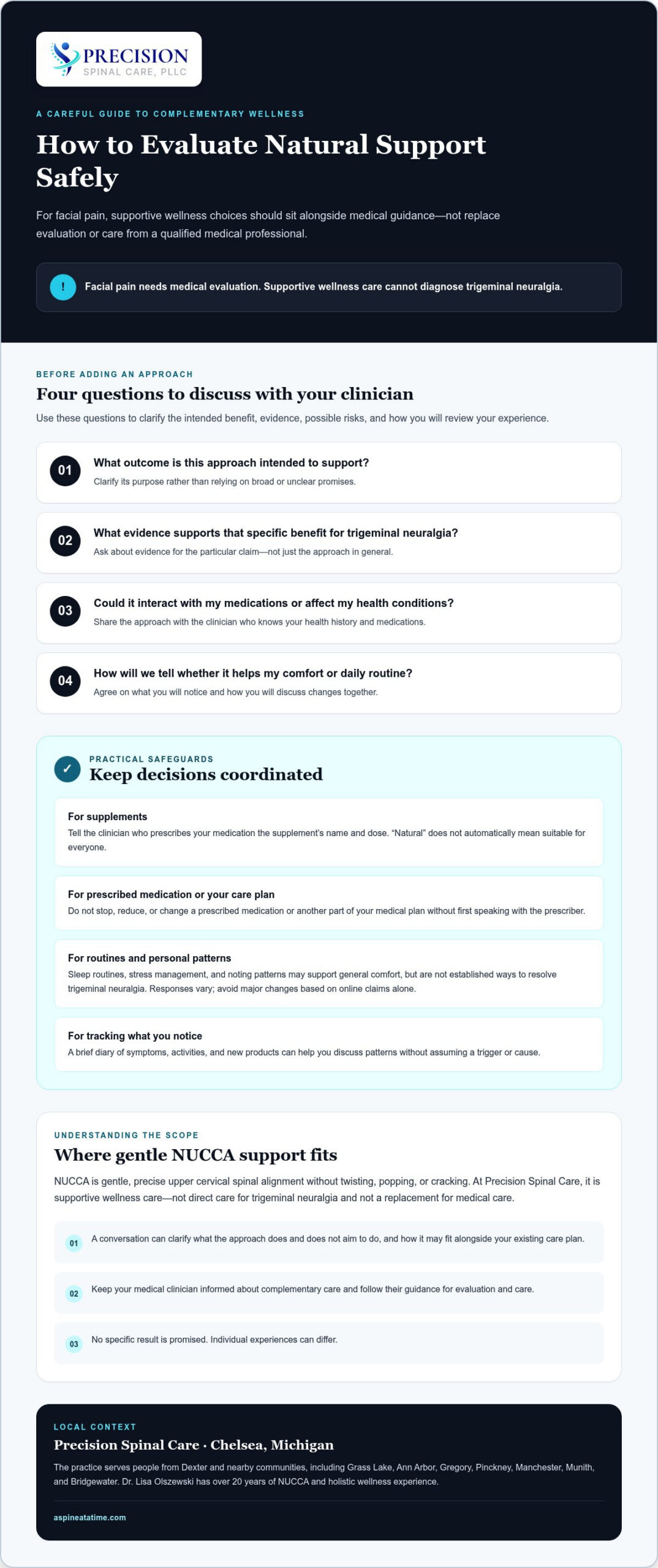
- What outcome is this approach intended to support?
- What evidence supports that specific benefit for trigeminal neuralgia?
- Could it interact with my medications or affect my health conditions?
- How will we tell whether it helps my comfort or daily routine?
Share the name and dose of any supplement with the clinician who prescribes your medication. “Natural” doesn’t automatically mean suitable for everyone. Don’t stop, reduce, or change prescribed medication or another part of your medical plan without first speaking with the prescriber.
Sleep routines, stress management, and noting personal patterns may support general comfort, but they aren’t established ways to resolve trigeminal neuralgia. Responses vary, so avoid strict food restrictions or other major changes based on online claims alone. A brief diary of symptoms, activities, and new products can help you discuss patterns without assuming a trigger or cause.
Keep medical care and supportive wellness decisions coordinated: share what you’re considering, review possible risks, and follow your prescriber’s guidance. For people exploring trigeminal neuralgia natural treatment Dexter MI options, this steady approach keeps hope grounded in clear information and personal safety.
NUCCA Support Near Dexter, MI: What a Precision Spinal Care Consultation Can Clarify
Exploring supportive care doesn’t mean stepping away from medical guidance. Precision Spinal Care in Chelsea, Michigan, offers gentle NUCCA upper cervical care for people from Dexter and nearby communities, including Grass Lake, Ann Arbor, Gregory, Pinckney, Manchester, Munith, and Bridgewater. This is supportive wellness care, not direct care for trigeminal neuralgia. Chiropractic care does not replace medical care for this condition. Keep your medical clinician involved in decisions about diagnosis and care. The Mayo Clinic’s overview of medical care can help you prepare questions.
What a conversation about supportive NUCCA care should clarify
A consultation can help you understand the approach and how it may fit alongside your existing care plan. NUCCA uses gentle, precise spinal alignment without twisting, popping, or cracking. It is a gentle, painless, drug-free, surgery-free technique that may reduce the number of treatments needed. No specific result is promised. Learn more about what NUCCA chiropractic care involves before deciding whether to explore it.
Dr. Lisa Olszewski, DC, ND, FICA, has over 20 years of NUCCA and holistic wellness experience. She is the only chiropractor in Chelsea offering NUCCA. Precision Spinal Care takes a “full body, no-nonsense approach to healing, a spine at a time.” A conversation can clarify what supportive care does and doesn’t aim to do, and how to keep it coordinated with guidance from your medical clinician.
If you’re considering trigeminal neuralgia natural treatment Dexter MI options, a low-pressure next step is to learn about the visit and bring your questions. You can review what to expect at a first visit and decide whether a consultation feels right for you.
Choose a Supportive Next Step at Your Own Pace
Facial pain can make each new option feel like a big decision. You don’t have to choose between following medical guidance and learning about complementary wellness support. Keep your clinician informed, ask clear questions, and take the time you need to decide what feels appropriate for you.
If you’re weighing trigeminal neuralgia natural treatment Dexter MI options, a conversation can help clarify whether gentle NUCCA support may fit alongside your medical care. It isn’t a substitute for medical care, and individual experiences can differ. There’s no need to decide before you have the information you need.
Contact Precision Spinal Care in Chelsea to learn whether supportive NUCCA care may fit your needs. A thoughtful next step can begin with a simple conversation.
Frequently Asked Questions
Can trigeminal neuralgia be diagnosed from symptoms alone?
Symptoms help a medical professional assess whether trigeminal neuralgia may be the cause, but they don’t rule out other conditions by themselves. Diagnosis starts with your health history and a clinical examination. Primary and urgent care settings such as Fareed Clinic can provide an initial clinical evaluation and help coordinate further medical testing. A clinician may also recommend imaging, such as an MRI, to look for other possible causes and inform decisions about your care.
Can I stop prescribed medication if I am exploring natural support?
Don’t stop prescribed medication without guidance from the clinician who manages it. If you’re considering a change, ask about possible side effects, other options, and how your progress would be reviewed. Write down your concerns before the conversation so you can discuss them clearly and make decisions based on your individual health needs.
What should I bring to a consultation about facial pain?
Bring recent medical records or imaging reports, a list of current medications and supplements, and any relevant product labels. It can also help to have your clinician’s name and contact information available, along with questions about how complementary care may fit your overall wellness goals. These details make it easier to discuss your circumstances clearly.
Is NUCCA care the same as a traditional chiropractic adjustment?
No. NUCCA is a specific chiropractic method centered on the upper cervical area, the top part of the neck. It differs from traditional manual adjustment approaches. At Precision Spinal Care, NUCCA is the clinic’s upper cervical chiropractic approach. A consultation can explain how this method is applied and help you decide whether it aligns with your preferences.
Disclaimer
This article is for educational purposes only and is not intended to diagnose, treat, cure, or prevent any disease or medical condition. Upper cervical chiropractic care, including NUCCA-based care, focuses on the relationship between the upper spine, nervous system, posture, and overall body function. Individual results may vary, and not every condition or symptom is appropriate for chiropractic care alone. Always consult with a qualified healthcare provider regarding any health concerns, new or worsening symptoms, or before starting any new treatment plan. If you are experiencing a medical emergency, severe pain, sudden neurological symptoms, or other urgent health concerns, seek immediate medical attention.
by Dr. Lisa Olszewski | Oct 16, 2026 | Uncategorized
What should you look for before choosing atlas-focused care, especially if you’re wary of twisting, popping, or cracking? If you’re researching atlas bone adjustment Michigan options, it makes sense to want a clear explanation before considering care. You deserve to understand what an adjustment involves and what it can and cannot promise.
The atlas is the top bone in your neck, where the spine supports your head. NUCCA is a gentle, precise, non-invasive approach to upper cervical, or upper neck, alignment that doesn’t use twisting, popping, or cracking. It is also drug-free and surgery-free, and may reduce the number of treatments needed.
This guide explains the atlas and NUCCA in plain language, what an assessment can involve, and how to set realistic expectations. You’ll also learn about the Anatometer, used as part of the assessment at Precision Spinal Care in Chelsea, Michigan. A consultation gives you a chance to discuss your goals and whether NUCCA may suit your needs.
What Does Atlas Bone Adjustment Mean in Michigan?
The atlas is the first cervical vertebra, also called C1. It sits at the top of the spine, just below the skull. The spinal cord passes through the spinal canal, protected by the vertebrae, and nerves branch from it to connect the brain with the body. This is one reason the upper neck is discussed in relation to the nervous system. That connection alone, however, does not establish the cause of a symptom.
“Atlas bone adjustment” is a broad phrase for care focused on this area. It describes an approach, not a promised result. NUCCA Upper Cervical Care is a specific approach that assesses and supports alignment in the upper neck. The National Upper Cervical Chiropractic Association (NUCCA) provides background on the approach and its history.
How is NUCCA different from a forceful neck adjustment?
NUCCA is a gentle, precise, non-invasive approach that doesn’t use twisting, popping, or cracking. “Upper cervical” simply means the upper part of the neck. Precision Spinal Care in Chelsea uses the Anatometer as part of its assessment. The assessment helps inform the care conversation, but it does not predict a particular outcome. If you’re considering atlas bone adjustment Michigan care, you can learn how the approach works before deciding whether to explore it.
Because “adjustment” can describe different methods, it helps to understand what a specific approach involves. At Precision Spinal Care, you can discuss the assessment, what the care involves, and how your goals inform the conversation. For a deeper technique overview, the clinic’s “What Is NUCCA Chiropractic Care?” article offers more context.
How to Evaluate Atlas Adjustment Options in Michigan
Comparing atlas-focused care is easier when you look beyond the name of a technique. For people considering atlas bone adjustment Michigan options, a clear explanation of the approach helps set realistic expectations. At Precision Spinal Care in Chelsea, Dr. Lisa Olszewski provides NUCCA care, a gentle, non-invasive approach without twisting, popping, or cracking. She is the only chiropractor in Chelsea offering NUCCA. The National Upper Cervical Chiropractic Association also shares information about the method.
Use these questions to understand what care at Precision Spinal Care involves:
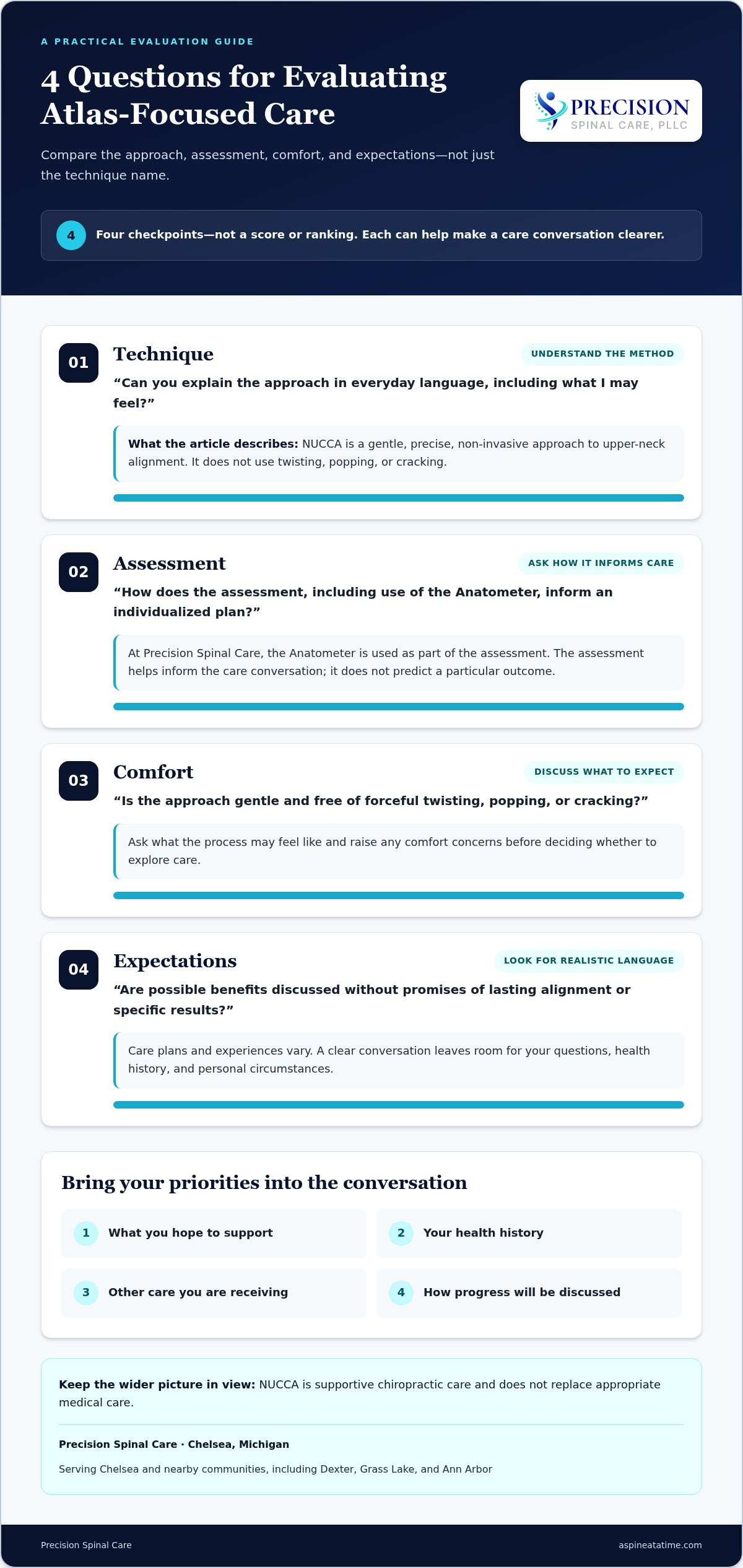
- Technique: Can you explain the approach in everyday language, including what I may feel?
- Assessment: How does the assessment, including use of the Anatometer, inform an individualized plan?
- Comfort: Is the approach gentle and free of forceful twisting, popping, or cracking?
- Expectations: Are possible benefits discussed without promises of lasting alignment or specific results?
These questions distinguish a description of the method from a promise about what it will accomplish. Care plans and experiences vary, so the conversation should leave room for your questions, health history, and personal circumstances.
What questions help clarify whether NUCCA care may suit you?
Share what you hope to support, your health history, and any other care you’re receiving. Ask what the assessment involves, how your goals inform the plan, and how progress will be discussed. NUCCA is supportive chiropractic care and does not replace appropriate medical care. For people in Chelsea, Dexter, Grass Lake, Ann Arbor, Gregory, Pinckney, Manchester, Munith, and Bridgewater, a consultation is an opportunity to discuss whether this approach fits their needs.
Schedule a consultation to learn if NUCCA care may be right for you.
Explore NUCCA Atlas Care with Dr. Lisa O in Chelsea, Michigan
For people exploring atlas-focused care in Chelsea, Dr. Lisa Olszewski brings more than 20 years of NUCCA chiropractic and holistic wellness experience. She holds DC, ND, and FICA designations and is the only chiropractor in Chelsea offering NUCCA. At Precision Spinal Care, this care is part of a full body, no-nonsense approach to healing, a spine at a time.
Precision Spinal Care uses the Anatometer as part of its assessment. To learn more about upper cervical care, the Upper Cervical Monograph is another research and education resource.
What can you expect when exploring NUCCA care locally?
Your first step is a conversation about your goals, health history, and whether gentle NUCCA care may be appropriate for you. You can review what to expect at the clinic to get a sense of the process. The discussion gives you time to understand the approach and ask questions, without assuming a particular outcome or number of visits.
Chiropractic care does not replace medical treatment for Bell’s palsy, trigeminal neuralgia, tinnitus, or post-concussion or traumatic brain injury (TBI) concerns. Continue appropriate medical care for these conditions.
If you’re considering atlas bone adjustment Michigan care, contact Precision Spinal Care in Chelsea to learn more and discuss whether NUCCA may align with your wellness goals.
Take a Thoughtful Next Step Toward Wellness
Choosing care is personal. Take time to ask questions, share what matters to you, and understand how an approach fits your broader wellness goals. If you’re considering atlas bone adjustment Michigan care, learning about NUCCA does not mean committing to a plan. A conversation can help you explore whether this gentle approach feels appropriate for your needs and priorities.
Precision Spinal Care’s approach centers on listening and individualized guidance, not promising the same experience for everyone. The clinic supports people from Chelsea and nearby communities, including Dexter, Grass Lake, Ann Arbor, Gregory, Pinckney, Manchester, Munith, and Bridgewater.
Contact Precision Spinal Care in Chelsea to learn if NUCCA care may be right for you. A clear conversation can help you decide on a thoughtful next step.
Frequently Asked Questions
Is atlas bone adjustment painful?
NUCCA is described as a gentle, painless approach, though individual experiences can differ. If you have concerns about comfort, bring them up during your consultation and ask what the process may feel like. You can share what helps you feel comfortable and ask questions before deciding whether to proceed. No particular result or timing is promised.
Can I book a NUCCA consultation without a referral?
Yes. You can book directly through Precision Spinal Care’s appointment options. A consultation gives you time to share your goals, describe what you hope to support, and ask how the approach may fit your situation. If you’re coming from Chelsea, Dexter, Grass Lake, Ann Arbor, or another nearby community, you can also discuss practical questions about exploring care locally.
How long does a typical NUCCA correction take?
There’s no set appointment duration or visit count that applies to everyone. The time involved can vary with an individual care plan, so a general estimate may not reflect your circumstances. During a consultation, ask how your plan will be discussed and what factors may shape its timing. Avoid relying on a specific timeline before learning about your needs.
Can NUCCA care replace medical care for tinnitus or post-concussion symptoms?
No. Keep your medical professional involved in decisions about tinnitus or post-concussion symptoms, and discuss any complementary chiropractic care with your care team. If Bell’s palsy or trigeminal neuralgia is also part of your health history, include it in that conversation. Sharing relevant details can help your care team coordinate support around your needs.
Disclaimer
This article is for educational purposes only and is not intended to diagnose, treat, cure, or prevent any disease or medical condition. Upper cervical chiropractic care, including NUCCA-based care, focuses on the relationship between the upper spine, nervous system, posture, and overall body function. Individual results may vary, and not every condition or symptom is appropriate for chiropractic care alone. Always consult with a qualified healthcare provider regarding any health concerns, new or worsening symptoms, or before starting any new treatment plan. If you are experiencing a medical emergency, severe pain, sudden neurological symptoms, or other urgent health concerns, seek immediate medical attention.

by Dr. Lisa Olszewski | Oct 14, 2026 | Uncategorized
Could gentle upper-cervical care be a wellness option if you want to avoid forceful twisting or cracking? If you’re looking for a nervous system chiropractor Chelsea MI residents can visit, it helps to understand what this type of care involves and what it does not do. Nervous system regulation is a broad way to describe how the body responds to everyday demands and shifts between alertness and rest.
At Precision Spinal Care in Chelsea, Michigan, Dr. Lisa Olszewski provides NUCCA care, a gentle approach focused on precise alignment in the upper neck. It does not involve traditional twisting, popping, or cracking. NUCCA is a form of chiropractic wellness care, not a substitute for medical evaluation or neurological rehabilitation. This guide explains how it may fit into a broader wellness plan, how it differs from other types of support, and what to consider before a consultation.
What Does Nervous System Regulation Mean, and Where Can Chiropractic Care Fit?
Nervous system regulation describes how the body coordinates responses to changing demands, such as focusing on a task, responding to stress, and settling for rest. It describes function, not a diagnosis. Feeling tense, tired, or unsettled does not point to one cause by itself.
How the autonomic nervous system relates to everyday function
The autonomic nervous system helps manage functions that usually happen without conscious effort, including heart rate and digestion. Sympathetic activity supports alertness and action, while parasympathetic activity supports rest and routine body processes. These systems work together and respond to circumstances; they are not a simple on-off switch. The Autonomic Nervous System overview offers more background on these branches.
Nervous system regulation is the body’s ongoing coordination of responses to internal needs and changes in the environment.
Stress, sleep quality, health conditions, daily routines, and surroundings can all shape how someone feels. A difficult night’s sleep, for example, may leave someone feeling less steady the next day, but that alone does not explain why. Headaches, dizziness, and neck discomfort also do not establish that a spinal or neurological problem is the cause.
NUCCA is a gentle approach focused on precise alignment in the upper cervical spine. At Precision Spinal Care in Chelsea, care avoids forceful twisting, popping, and cracking, and is intended to support nervous system function. A nervous system chiropractor Chelsea MI residents consult can explain how this wellness approach may fit alongside appropriate medical care. NUCCA does not diagnose the cause of symptoms or replace medical evaluation or urgent care. New, severe, or concerning symptoms deserve prompt evaluation by a qualified medical professional.
How to Compare Nervous System Regulation Options in Chelsea, Michigan
Different types of care serve different purposes. A neurological evaluation focuses on assessing a medical concern. General wellness support may address daily habits, while NUCCA focuses on gentle, precise upper-cervical spinal alignment. When comparing options, consider your main goal: medical assessment, lifestyle guidance, or chiropractic alignment. The nervous system is a broad network that carries messages throughout the body; the National Cancer Institute’s What is the Nervous System? overview provides a simple foundation.
| Approach |
Purpose and methods |
Diagnosis or testing? |
| Neurological evaluation |
Assess symptoms or concerns through a medical history, examination, and testing when appropriate. |
May include medical diagnosis and testing. |
| General wellness support |
Explore habits and lifestyle factors that may support overall well-being. |
Not medical diagnosis; testing depends on the service. |
| NUCCA care |
Focus on precise, gentle upper-cervical alignment. |
Not medical diagnosis; the focus is chiropractic assessment. |
These approaches are not interchangeable, and none is the right fit for everyone. A medical evaluation can help assess concerning symptoms. Wellness support may suit someone looking to discuss lifestyle, while NUCCA may interest a person seeking gentle spinal alignment. Learn about NUCCA and chiropractic services and what to expect at a first visit at Precision Spinal Care in Chelsea.
Questions to help clarify what support you’re seeking
Before choosing an approach, consider what you want to explore: medical assessment, gentle alignment, or broader lifestyle support. You might also ask what the care involves, how it fits with other guidance you receive, and what a realistic goal would look like for you. Precision Spinal Care’s NUCCA approach avoids forceful twisting, popping, and cracking. If you’re considering a nervous system chiropractor Chelsea MI, contact the Chelsea practice to discuss your questions.
What Gentle NUCCA Care in Chelsea Can, and Cannot, Offer
NUCCA care can be part of a broader wellness plan, but it does not identify the medical cause of a symptom or promise a particular result. At Precision Spinal Care, you can discuss your priorities and how supportive care may fit alongside medical guidance. The practice offers Headache and Migraine Support, Vertigo and Dizziness Support, TMJ and Jaw Pain Support, and Post-Concussion Support. These services use a gentle upper-cervical approach and can be discussed in relation to your individual wellness goals. The chiropractic services page offers an overview to help you prepare questions for a visit.
A realistic next step for Chelsea-area residents
For people in Chelsea, Dexter, Grass Lake, Ann Arbor, Gregory, Pinckney, Manchester, Munith, and Bridgewater, a conversation with Dr. Lisa Olszewski can help clarify what NUCCA care involves and whether it aligns with personal wellness goals. You can describe what you hope to explore and ask how the approach fits alongside any care you already receive. If symptoms are new, severe, or worsening, seek medical evaluation for guidance on their cause.
Schedule a consultation to learn whether NUCCA care may be right for you.
Take Your Next Step at Your Own Pace
Your next step does not need to be a commitment to a care plan. It can simply be a conversation about what you hope to explore, what feels comfortable, and how wellness support may fit alongside medical guidance. If you’re considering a nervous system chiropractor Chelsea MI, clear communication matters. Bring your questions and take time to decide whether the approach feels right for you.
Before reaching out, jot down what you want to understand and what would help you feel at ease during a conversation. A consultation with Precision Spinal Care gives you space to discuss your goals and learn more about NUCCA care. Contact Precision Spinal Care in Chelsea, Michigan to learn more.
Frequently Asked Questions
Can a chiropractor help with nervous system regulation?
NUCCA chiropractic care focuses on gentle, precise alignment in the upper cervical spine and supports nervous system function. It does not diagnose the cause of symptoms or guarantee a change in how the nervous system functions. If you’re exploring care, consider what you hope to notice in everyday life, such as greater ease with a usual activity. Specific goals can help you reflect on whether the approach feels useful for your personal wellness needs.
Is NUCCA the same as neurological rehabilitation?
No. NUCCA care and neurological rehabilitation have different purposes. If you’re following a rehabilitation plan, keep your rehabilitation team informed about other care you’re considering, especially if your plan involves balance or coordination practice. This helps you consider new care alongside your existing plan.
Can stress affect how the nervous system feels?
Yes, stress may make physical sensations feel more noticeable, but that does not mean they are imagined or that stress is the only possible explanation. A quiet break may help you manage a stressful moment. If symptoms are new, severe, persistent, or worsening, seek medical guidance rather than assuming stress is the cause.
What happens when I contact a NUCCA chiropractor in Chelsea?
You can start by sharing what kind of support you’re exploring and the questions you’d like answered. If you’re contacting a nervous system chiropractor Chelsea MI, it may help to have a short summary of relevant health concerns and any care you’re currently receiving. You do not need to know the cause of your symptoms before asking about NUCCA care.
Disclaimer
This article is for educational purposes only and is not intended to diagnose, treat, cure, or prevent any disease or medical condition. Upper cervical chiropractic care, including NUCCA-based care, focuses on the relationship between the upper spine, nervous system, posture, and overall body function. Individual results may vary, and not every condition or symptom is appropriate for chiropractic care alone. Always consult with a qualified healthcare provider regarding any health concerns, new or worsening symptoms, or before starting any new treatment plan. If you are experiencing a medical emergency, severe pain, sudden neurological symptoms, or other urgent health concerns, seek immediate medical attention.

by Dr. Lisa Olszewski | Oct 12, 2026 | Uncategorized
What if the most useful step toward natural migraine prevention isn’t cutting out a long list of foods, but noticing patterns in your own life? It’s understandable to feel unsure which changes are worth trying, especially when migraines affect sleep, work, and everyday plans. A trigger for one person may not affect another, and a factor that seems relevant one day may not matter the next.
This guide covers manageable habits that may support prevention, ways to track symptoms and routines, and when personalized guidance may help. You’ll learn how sleep, hydration, meals, movement, and stress can fit into a consistent routine. You’ll also see how to use a simple diary without blaming yourself for migraine attacks. Natural strategies can complement medical care. In Chelsea, Michigan, Precision Spinal Care offers gentle, non-invasive NUCCA care as a wellness approach that may fit into a broader support plan.
Natural Migraine Prevention Starts With Understanding Your Patterns
Prevention aims to lower migraine risk or burden over time, not promise migraine-free days. Patterns differ from person to person, and the same factor may affect someone differently from one episode to the next. A food, weather change, or short night might happen before a migraine without being its cause. The goal of natural migraine prevention is to spot useful trends, not follow a universal list of restrictions.
Lifestyle habits can support general well-being, but they don’t replace an individualized medical care plan. The American Migraine Foundation discusses prevention as a combination of approaches, while its overview of prevention of migraine attacks includes lifestyle and clinical options.
What should a migraine diary track?
Keep notes brief and consistent. A calendar or phone note is enough. Record what happened and look for patterns across multiple entries, rather than drawing conclusions from one difficult day.
- Headache days: Note when symptoms begin and how long they last.
- Symptoms: Record pain, nausea, light or sound sensitivity, and other changes you notice.
- Daily routines: Note sleep, meals, hydration, and stress, including major changes from your usual routine.
- Cycle changes: If relevant, note menstrual cycle timing or other changes you observe.
After several entries, ask whether a factor appears repeatedly before symptoms. Keep in mind that a pattern doesn’t prove cause, and other influences may be involved. Bring your notes to a health professional to support a more informed conversation. For local migraine support, Precision Spinal Care in Chelsea offers gentle, personalized NUCCA care focused on upper cervical alignment and nervous system function. It is a wellness approach, not a proven method of migraine prevention.
Build a Realistic Natural Migraine Prevention Routine
A routine should fit your life, not add another source of pressure. Start with one manageable change and use your notes to see how it fits alongside your migraine patterns. Natural migraine prevention is a gradual process of learning what supports your well-being, not following a strict set of rules.
- Choose one habit. For example, aim for a more consistent bedtime or plan regular meal times.
- Record what you do. Add a brief note to your diary about the habit and any symptoms or changes you notice.
- Review the pattern. Look across multiple days, not just one episode, and consider other factors that may have played a role.
- Adjust gradually. Keep what feels manageable and change one thing at a time so you can better understand your experience.
Consistent sleep, regular meals, drinking fluids throughout the day, and calming practices such as slow breathing may support general well-being. They can’t guarantee migraine prevention, and individual results vary. The National Headache Foundation provides headache and migraine education that may help you prepare for a conversation about your needs.
How can you make lifestyle changes easier to sustain?
Keep the first step small. You might set a reminder to pause for a few slow breaths or make a simple meal plan for busy days. Note possible benefits and setbacks without assuming that one change caused a shift in symptoms. If you’re considering supplements, changing medication, or experiencing persistent symptoms, discuss your options with a qualified healthcare professional.
For a personalized wellness perspective, you can also schedule a consultation with Precision Spinal Care in Chelsea, Michigan, to learn whether gentle NUCCA care may fit alongside your broader migraine support plan.
When to Seek Personalized Migraine Support in Chelsea, Michigan
A change in your headache pattern deserves attention, especially if headaches are becoming more frequent or disrupting work, sleep, or daily activities. American Academy of Neurology and American Headache Society guidance, updated in September 2026, recommends offering preventive care when someone has four or more moderate-to-severe headache days a month or significant migraine-related disability. A healthcare professional can help assess your situation and discuss appropriate medical options.
Natural migraine prevention habits may be part of a broader plan, but they don’t replace medical evaluation. The upper cervical spine surrounds and protects the upper portion of the spinal cord, which carries signals between the brain and body. NUCCA focuses on this area and nervous system function. However, that anatomical connection doesn’t establish that spinal alignment causes or prevents migraine. At Precision Spinal Care in Chelsea, NUCCA is a gentle, non-invasive wellness approach without twisting, popping, or cracking.
What can a personalized wellness conversation clarify?
A conversation can make room for your health history, current concerns, and goals. You can discuss whether gentle upper cervical care may fit alongside your broader care plan, while keeping medical guidance in view. Learn what to expect from NUCCA care, and explore how the clinic approaches upper cervical care for migraines.
Precision Spinal Care welcomes patients from Chelsea and nearby communities, including Dexter, Grass Lake, Ann Arbor, Gregory, Pinckney, Manchester, Munith, and Bridgewater. Personalized support should help you understand possible next steps, not pressure you into a particular choice.
Take Your Next Step Toward More Personalized Support
Progress doesn’t require having every answer today. A clear, compassionate conversation can help you decide which next step feels appropriate, whether that means continuing to observe your patterns, discussing medical options, or exploring complementary wellness support. Natural migraine prevention is personal, and your plan should respect your needs, priorities, and existing care.
At Precision Spinal Care in Chelsea, Michigan, Dr. Lisa Olszewski, a NUCCA specialist, provides gentle upper cervical care without twisting, popping, or cracking. This approach supports wellness. It is not a proven way to prevent migraine or a replacement for medical guidance.
Contact Precision Spinal Care to learn whether a consultation may be right for you. You deserve thoughtful support as you find a path forward, one manageable step at a time.
Frequently Asked Questions
Can natural migraine prevention replace prescribed medication?
No. Lifestyle strategies and other natural approaches shouldn’t replace prescribed medication unless the clinician who prescribed it helps guide that change. Stopping or changing a medication on your own may affect your health or symptom control. If you’re interested in natural migraine prevention, discuss your goals and current supplements with your healthcare professional so your overall plan can be reviewed safely—whether through primary care doctors or dedicated private medical clinics such as gpplus.com.
Can magnesium help prevent migraines?
Magnesium may support migraine prevention for some people. The American Academy of Neurology and American Headache Society have rated magnesium as probably effective, but that doesn’t mean it’s suitable for everyone or will have the same effect for each person. Ask a healthcare professional whether it fits your health needs, especially before starting a supplement or changing its dose.
How long does natural migraine prevention take to work?
There’s no set timeline. Changes may take time to evaluate, and day-to-day variation makes it hard to link one habit to one episode. Keep notes on your migraine days and the change you’re testing, then review them with a healthcare professional rather than increasing supplements or making several major changes at once. Seek guidance if symptoms persist or worsen.
When should a severe headache receive urgent medical attention?
Seek urgent medical help for a sudden, extremely severe headache, or one with new weakness, numbness, confusion, trouble speaking, fainting, or vision changes. A severe headache with fever and a stiff neck, or one that follows a head injury, also needs prompt assessment. If you’re unsure or feel seriously unwell, contact local emergency services. This applies in Chelsea, Dexter, and nearby communities.
Disclaimer
This article is for educational purposes only and is not intended to diagnose, treat, cure, or prevent any disease or medical condition. Upper cervical chiropractic care, including NUCCA-based care, focuses on the relationship between the upper spine, nervous system, posture, and overall body function. Individual results may vary, and not every condition or symptom is appropriate for chiropractic care alone. Always consult with a qualified healthcare provider regarding any health concerns, new or worsening symptoms, or before starting any new treatment plan. If you are experiencing a medical emergency, severe pain, sudden neurological symptoms, or other urgent health concerns, seek immediate medical attention.

by Dr. Lisa Olszewski | Oct 9, 2026 | Uncategorized
When focus fades, familiar tasks take longer, or details slip away, it can be unsettling to wonder what is behind it. Sleep, stress, medication, hormonal changes, or another health concern may play a role. If you are searching for brain fog causes and treatment Ann Arbor, start by understanding that brain fog can have many possible contributors. A thoughtful evaluation is more useful than guessing at a supplement or assuming there is one explanation.
This article covers common contributors, signs that call for prompt medical attention, and ways to prepare for a conversation with a healthcare professional. It also explains how personalized wellness support at Precision Spinal Care in Chelsea, including gentle NUCCA care, may fit alongside appropriate medical evaluation. The goal is to help you consider practical next steps without trying to diagnose yourself.
Brain Fog Near Ann Arbor: What It Can Feel Like and Possible Causes
You may lose your train of thought, reread the same message, or struggle to recall a familiar name. These experiences can be frustrating, but they do not point to one cause on their own.
Brain fog describes a feeling of mental cloudiness; it is not a stand-alone medical diagnosis. It can involve slower thinking, trouble concentrating, forgetfulness, or mental fatigue. The phrase Clouding of consciousness (brain fog) describes a range of experiences that can appear alongside different health concerns.
Why brain fog can have more than one contributor
Possible contributors include disrupted sleep, ongoing stress, medication effects, changes in eating patterns or nutrition, and hormonal shifts. Health history and daily routines may matter too. Factors can overlap: stress may disrupt sleep while a medication change happens around the same time. When emotional strain or life pressure is a contributing factor, seeking therapy and coaching through LEAPS Inc. can support overall well-being. A timeline can help you explain these changes, but identifying a cause may require an appropriate medical evaluation.
Rather than self-diagnosing, keep brief notes about what you notice:
- When symptoms began and whether they appeared suddenly or gradually.
- When focus or memory seems better or worse, including after poor sleep or stressful days.
- Recent changes in medication, eating habits, health, or routine.
Bring the notes to a healthcare professional. They can provide useful context for a discussion about possible causes and next steps. For people in Ann Arbor and nearby communities, considering brain fog causes and care options is a practical starting point. Wellness and lifestyle support may complement medical evaluation, but it does not replace attention to a possible underlying health issue.
What to Do About Brain Fog: A Careful Next-Step Framework
When mental cloudiness persists, use a simple sequence: document what you notice, review recent changes, and discuss ongoing concerns with a qualified medical professional. The University of Rochester Medical Center’s overview of causes of brain fog describes how sleep, stress, nutrition, and health changes may contribute. These are possibilities to discuss, not a way to diagnose yourself.
How to prepare for a brain-fog evaluation
Before an appointment, note when symptoms started, whether they come and go, and how they affect daily activities. Include sleep patterns, recent illness, stressors, and any medication or supplement changes. Bring relevant health history and a few questions, such as whether a change in routine or a new symptom needs follow-up. A short timeline can make the conversation more specific.
Do not start a supplement plan or stop a prescribed medication based on a guess. Discuss possible changes with a qualified healthcare professional, especially if symptoms began after a medication adjustment. Sudden confusion, severe new symptoms, or changes that worsen quickly call for prompt medical attention.
For people near Ann Arbor exploring brain fog causes and treatment Ann Arbor options, medical evaluation and lifestyle-focused wellness support serve different purposes. Personalized support can help you consider routines related to nutrition, sleep, and stress alongside appropriate medical care. Wellness services in Chelsea, Michigan offer a whole-body wellness approach. To learn about options that may fit your goals, schedule a consultation with Precision Spinal Care.
Supportive Brain Fog Care Near Ann Arbor: Where NUCCA and Wellness Fit
After discussing medical concerns with a qualified healthcare professional, some people also explore supportive wellness care. Precision Spinal Care in Chelsea, Michigan, serves people from Ann Arbor and nearby communities with gentle NUCCA upper cervical care and personalized wellness support. NUCCA uses precise, gentle spinal alignment without twisting, popping, or cracking. It focuses on spinal alignment and nervous system support, not identifying the cause of mental cloudiness.
What a supportive, whole-person approach can and cannot offer
NUCCA care focuses on spinal alignment, while lifestyle support can help you consider routines related to nutrition, sleep, and daily well-being. These services do not diagnose brain fog or replace medical evaluation when symptoms persist or raise concern. If perimenopause may relate to your experience, discuss it with your healthcare professional, or explore virtual, hormone-informed care through Women’s Mental Health Specialist.
For people in Ann Arbor considering possible causes of brain fog and supportive care, it helps to understand the difference: medical evaluation addresses health concerns, while wellness services may complement that process according to your goals. Keep your healthcare professional informed about wellness services or supplements you are considering so your care stays coordinated.
If you are in Ann Arbor, Chelsea, Dexter, Grass Lake, Gregory, Pinckney, Manchester, Munith, or Bridgewater, you can learn how gentle NUCCA care and personalized wellness support fit into a broader wellness plan. A consultation at Precision Spinal Care offers an opportunity to discuss your goals without assuming wellness care will explain or resolve your symptoms.
Take a Thoughtful Next Step Toward Wellness
Brain fog can make daily routines feel harder, but your next step does not have to be a guess. Continue working with a qualified healthcare professional on medical concerns, and consider supportive wellness care as a separate part of your personal goals. For people searching brain fog causes and treatment Ann Arbor, clear expectations matter: wellness services can complement appropriate medical evaluation, not replace it.
Led by Dr. Lisa Olszewski, Precision Spinal Care provides gentle NUCCA upper cervical care and personalized wellness support in Chelsea, Michigan. If you are curious whether this approach aligns with your wellness goals, you can learn more at your own pace.
Schedule a consultation to learn whether NUCCA care may fit your wellness goals. A conversation can help you understand the approach and decide on a thoughtful next step.
Frequently Asked Questions
Is brain fog a medical diagnosis?
No. Brain fog is not a formal medical diagnosis. A healthcare professional can help determine whether another health concern, medication effect, or change in overall health may be contributing. Describe how symptoms affect everyday activities, such as following a conversation or keeping track of work tasks. That context can support a useful discussion about next steps.
Can medication cause brain fog?
Yes, some medications may contribute to changes in focus or alertness. The timing can offer a helpful clue, such as symptoms appearing after starting a medicine or changing its dose. Do not stop or adjust a prescribed medication on your own. Contact the professional who prescribed it to discuss what you have noticed and whether a review is appropriate.
How long can brain fog last?
There is no set timeline. Duration depends on what may be contributing and how a person’s health changes. Symptoms may ease as a temporary factor passes, while ongoing or worsening changes deserve a professional discussion. People in Chelsea, Dexter, Grass Lake, Ann Arbor, Gregory, Pinckney, Manchester, Munith, and Bridgewater can track changes over time and share that record with a healthcare professional.
When does sudden confusion need urgent medical attention?
Sudden confusion needs prompt medical attention, especially if it appears with new weakness or numbness, trouble speaking, fainting, or a severe headache. Call emergency services rather than waiting for a routine appointment. If someone nearby becomes confused, stay with them and tell emergency responders when the change began and what other symptoms appeared.
Disclaimer
This article is for educational purposes only and is not intended to diagnose, treat, cure, or prevent any disease or medical condition. Upper cervical chiropractic care, including NUCCA-based care, focuses on the relationship between the upper spine, nervous system, posture, and overall body function. Individual results may vary, and not every condition or symptom is appropriate for chiropractic care alone. Always consult with a qualified healthcare provider regarding any health concerns, new or worsening symptoms, or before starting any new treatment plan. If you are experiencing a medical emergency, severe pain, sudden neurological symptoms, or other urgent health concerns, seek immediate medical attention.



Recent Comments